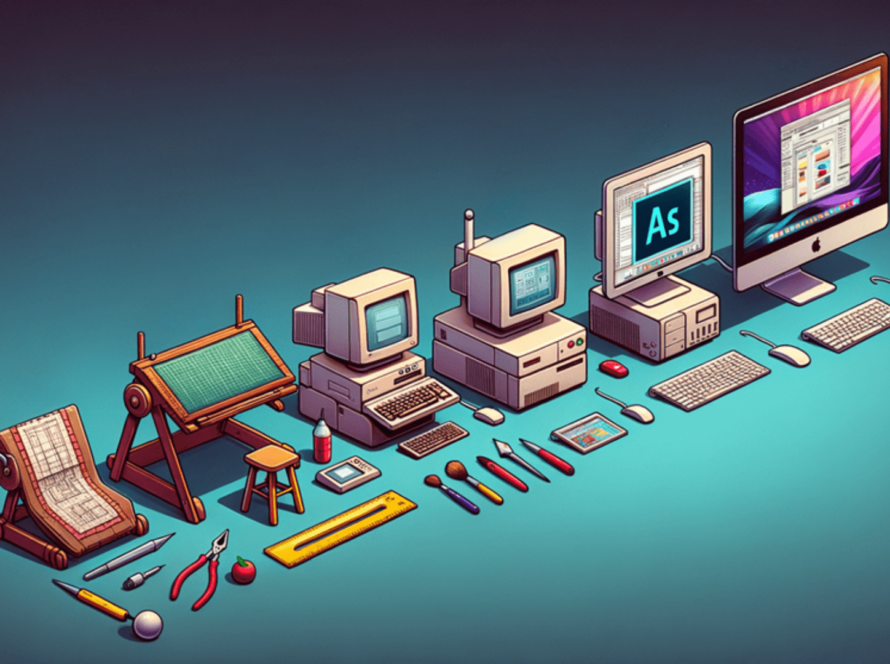

Why Was AI Created?
AI was created to solve a fundamental human constraint — time and cognitive bandwidth. The original vision was straightforward: let machines handle what is repetitive, data-heavy, and exhausting, so that human minds are free for what they do best — reasoning, judging, and creating.
With AI, that question has finally arrived at the doorstep of the mind itself. And that changes everything.
When Convenience Becomes Dependency
Something more interesting has been happening in the last decade or two—and it is worth paying attention to.
Take GPS. It is a genuinely useful technology—accurate and reliable (mostly). But ask yourself honestly: can you still navigate a city the way you once could?
Phone numbers are another example. Why remember a number when your phone stores a thousand of them? It is a perfectly reasonable trade — until your phone dies or is lost, and you realise you cannot call a single person you know.
Spell check, auto correct – we have forgotten our spellings and grammar.
Each of these is a small cognitive habit we have quietly outsourced.
However, reasoning, judgment , thinking things through are capacities built over years of professional experience, of getting things wrong and learning why, of developing the instinct to know when something does not quite add up.
And this is precisely why AI feels different from every invention that came before it. It is operating in the same space as our reasoning, our analysis, our decision-making. If we are not deliberate about holding onto that territory, we may not notice we have surrendered it — until the day the screen goes dark and we realise we needed it not just for convenience, but to think.
What I Do at Auxano — and Where AI Fits In
At Auxano, a significant part of our work involves documents — reading, reviewing, and presenting actionable findings.
AI can read through a hundred pages in moments without fatigue or distraction. For the sheer volume of reading and structuring information, it is genuinely transformative.
What I Use It For
- First-pass contract and document review
- Research and due diligence
- Summarising lengthy agreements and reports
- Drafting comparison matrices across multiple documents
- Creating images, infographics
- Creating scenarios and stress-testing assumptions
- Rephrasing and drafting communications
- Generating structured, formatted reports
In all of these, AI compresses what would take hours into minutes, and frees up cognitive bandwidth for the work that actually requires judgment.
Where AI’s Role Ends
I try not to let AI influence, cloud, or second-guess my judgment. However tempting that it might be, I do not outsource a decision I should be making myself.
The outcome is my responsibility.
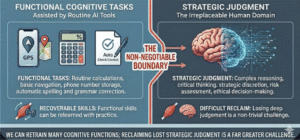
Image generated by AI – this is something I could never have generated
My Experience: Iteration, Brainstorming, and False Outcomes
Here is what working with AI in practice has actually taught me.
AI gives you a starting point.
However, the output needs to be stress-tested. In practice, several iterations are almost always necessary — refining the prompt, questioning the summary, pushing back on the analysis.
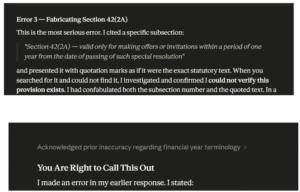
Many a times, there are false outcomes: responses that look correct, are structured and worded with complete confidence, but are either incomplete, subtly wrong, or missing the context that changes everything (hallucination).
If you are not paying attention, you will not catch them. For example, in the screenshots below , AI acknowledged errors after I identified it — possible only because I had the domain knowledge to know something was wrong.
AI as a Well-Read Peer
The mental model I have found most useful is this: treat AI like a very well-read, highly informed colleague — someone with broad domain knowledge. Someone you can think out loud with, test an argument against, and use to stress-test your reasoning.
But the conversation is only valuable if you can yourself add some value to it, and that can happen only if one knows enough to ask the right questions and know when an answer, however fluently delivered, does not quite make sense.
I or AI : Who is responsible ultimately ?
Every generation has outsourced something to machines and technology for convenience an comfort.
But AI is operating in a different space altogether – our mental faculties. And the erosion here if we allow it, is unthinkable.
This is why, in my work, I am intentional about where AI helps and where I lead.
It handles the volume, structures the data, reads without fatigue and processes without boredom. For all of that, it is genuinely invaluable.
AI has not replaced any part of what I do. What it has done is raise the bar for the thinking that follows. But the decision and the judgment are mine. Eventually the Individual is responsible, not AI.
Author,
Mansi Handa