
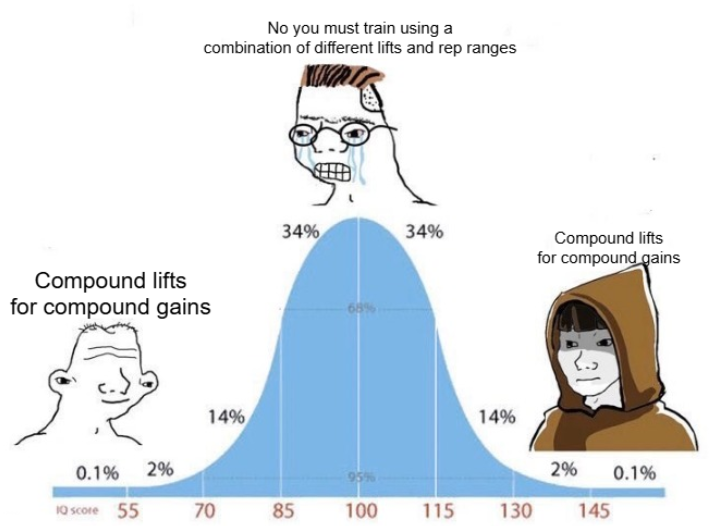
Walk into any gym and you will notice something odd. There are dozens of machines at the gym but if you ask a trainer the ten most important exercises, most of these would be barbell movements: the squat, the deadlift, the bench and the overhead press. These are compound lifts, i.e. they work several joints and muscle groups at once – i.e concentration, not diversification builds overall fitness.
Endurance science has arrived at a similar shape from the opposite direction:
- Studies of elite rowers and cross-country skiers found that they do roughly 80% of their training at low intensity and about 20% at high intensity. This came to be called “polarised” training.
- Quantified more precisely, that is 75-80% at low intensity, 15-20% at high intensity, and only ~5% at threshold, i.e. the moderately hard middle.
- In a 9-week study comparing four approaches (high volume, threshold, high-intensity intervals and polarised), the polarised group improved the most. The high-volume and threshold groups failed to produce any further improvement in endurance.
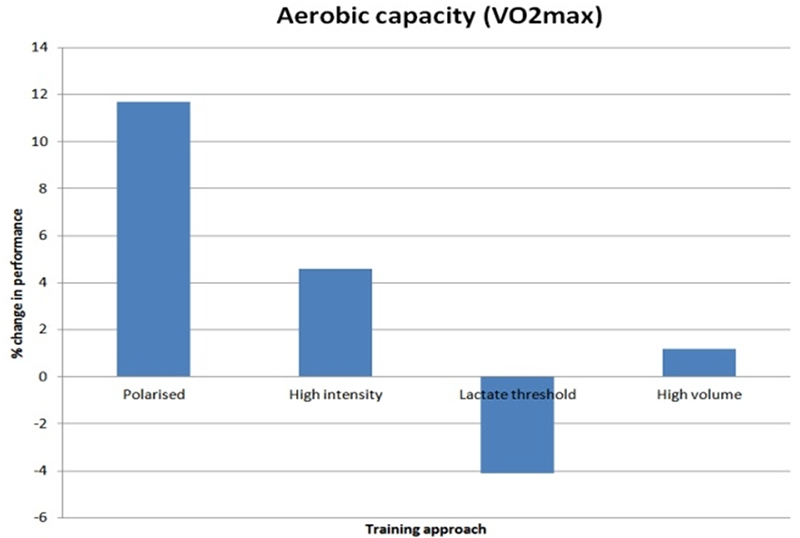
Thus by all accounts the best exercise methodology is not to follow a goldilocks approach (not too intense or too relaxed) but going at the two ends of the spectrum (‘the barbell’) with high intensity and relaxed workouts both incorporated. Turns out this phenomenon not only holds for fitness but also for business and investments at large.
Barbell to Bell Curve
Most of us are familiar with the most basic concept in statistics – the bell curve, or the normal distribution, where most observations cluster around an average and thin out evenly on either side. It is the reason we talk about “average” returns and “the typical company” with so much confidence.
Not every dataset has a single peak though. A bimodal distribution has two peaks with a valley in between, and when plotted, it looks a lot less like a bell and a lot more like a barbell. Anyone who has lived in South India has seen one:
· Kerala has two rainy seasons, the southwest monsoon in June/July, which brings the larger share, and the northeast monsoon in October/November.
· Tamil Nadu gets more rain in the northeast monsoon (October to December) than in the southwest one. That one season brings ~44 cm, or 48% of the state’s annual rainfall.
Few people have thought harder about the limits of the bell curve than Nassim Nicholas Taleb, a former options trader, who takes the same view to the gym. In Antifragile, he has argued that one extreme effort does more for strength than many small ones. Similar ideas are reflected in his other books
1. The Black Swan (2007): For centuries, Europeans used “black swan” as shorthand for something impossible, since every swan they had seen was white. Then, in 1697, Dutch explorers led by Willem de Vlamingh saw black swans in Western Australia. Taleb uses the term for events that are (i) outliers, beyond regular expectations, (ii) carry an extreme impact, and (iii) are explained away after the fact as if they were predictable.
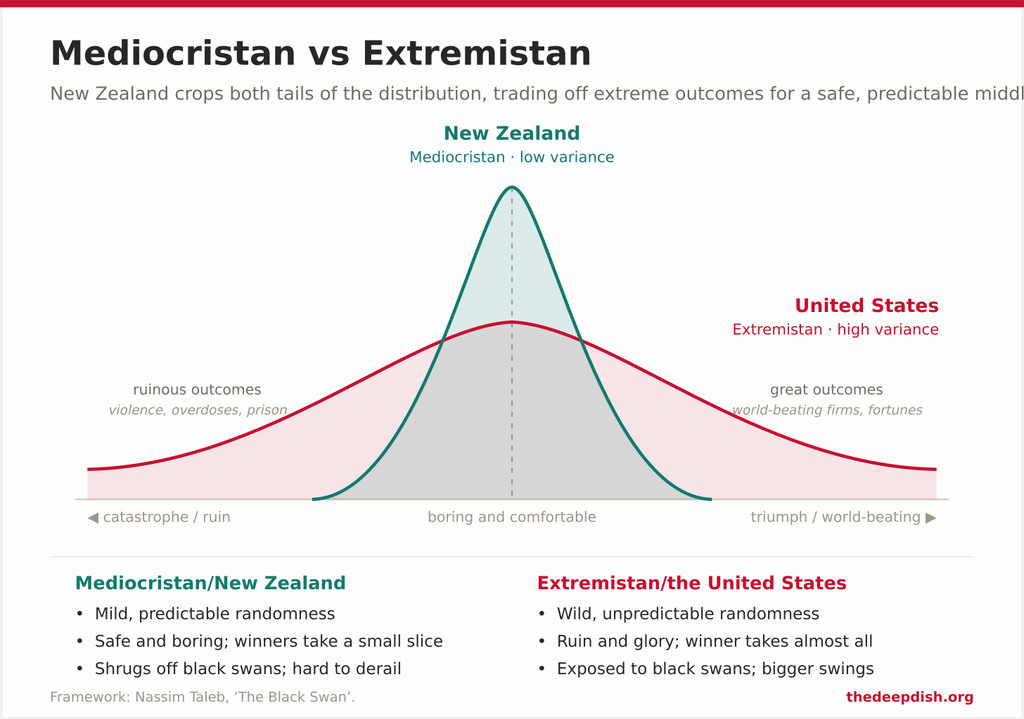
2. Mediocristan vs Extremistan: Put 1,000 random people in a stadium and add the heaviest person you can find, someone three times the average weight. He would still be only ~0.5% of the total weight. That is Mediocristan, where no single observation can move the total (height, weight, calories). Now add Bill Gates to the same stadium and ask what share of the total wealth he represents. The answer is close to all of it. That is Extremistan, where one observation can outweigh everything else combined (wealth, book sales, and, as Taleb puts it, “almost all social matters”)
3. The Barbell: Taleb’s answer to Extremistan is not to forecast better but to position differently. As a trader, he put 85-90% of his portfolio in extremely safe instruments and the remaining 10-15% in highly speculative bets. The downside is capped and known, while the upside is left open. In Antifragile (2012), he generalised it as avoiding the middle in favour of a combination of extremes.
Every Stop on the Line: Stages and Returns
Venture capital lives firmly in Extremistan (aka the Power Law). Returns do not follow a bell curve but a power law, where one or two companies can return more than the rest of a portfolio combined. The question then is not what the average company returns, but where along a company’s life the asymmetry is greatest.
Meta (then Facebook) is perhaps the cleanest illustration, since every stop on its journey is public record. Measured against its IPO valuation of $104 Bn in May 2012 (on paper and before dilution, so the real multiples are lower):
| Round | Date | Investor(s) | Valuation | Implied multiple at IPO |
| Angel | 2004 | Peter Thiel ($0.5 Mn for 10.2%) | $4.9 Mn | ~21,000x |
| Series A | May 2005 | Accel, Thiel ($12.7 Mn) | $87.5 Mn | ~1,190x |
| Series B | Apr 2006 | Accel, Greylock, Meritech, Thiel ($27.5 Mn) | $500 Mn | ~208x |
| Strategic | Oct 2007 | Microsoft ($240 Mn for 1.6%) | $15 Bn | ~6.9x |
| Growth | May 2009 | DST ($200 Mn) | $10 Bn | ~10.4x |
| Pre-IPO | Jan 2011 | Goldman Sachs, DST ($500 Mn) | $50 Bn | ~2.1x |
Inset: Meta: implied return by entry stage (Source 1, 2)
The early end is in a different league altogether. But look at the middle: Microsoft paid a $15 Bn valuation in 2007 and waited ~4.5 years for ~7x, while DST came in later at a lower $10 Bn and made ~10x in ~3 years. Goldman’s pre-IPO round doubled in about 16 months. The investor in the middle paid more, waited longer and earned less than the ones who came after it.
Thus there are essentially 2 entry points for an investor
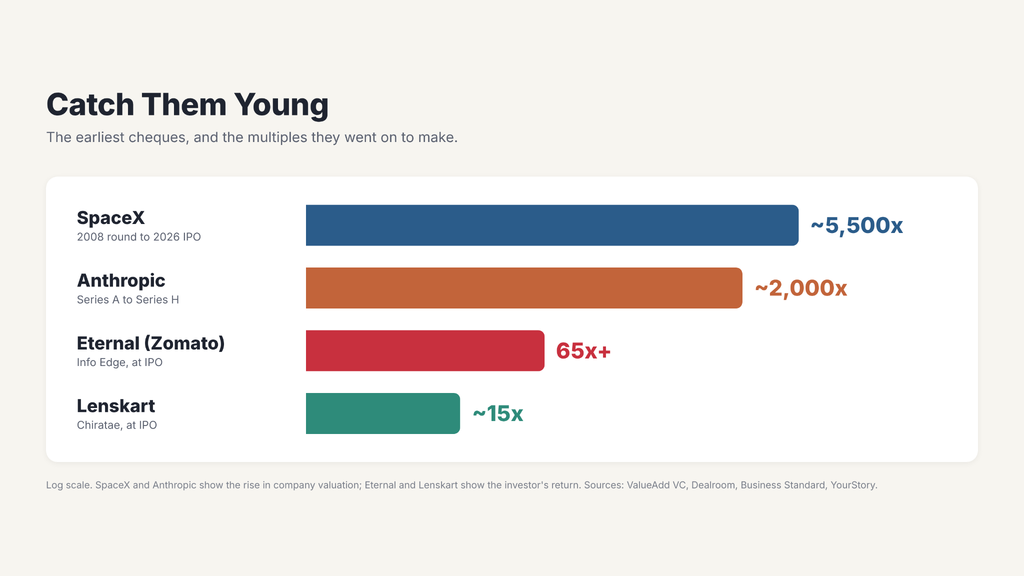
a) Early Stage (Catching them Young):
- Pre-Seed/Seed: an idea and a team with the lowest price, the highest risk and the longest wait.
- Series A / B: Early product-market fit. Risk falls, price rises, exit still years away.
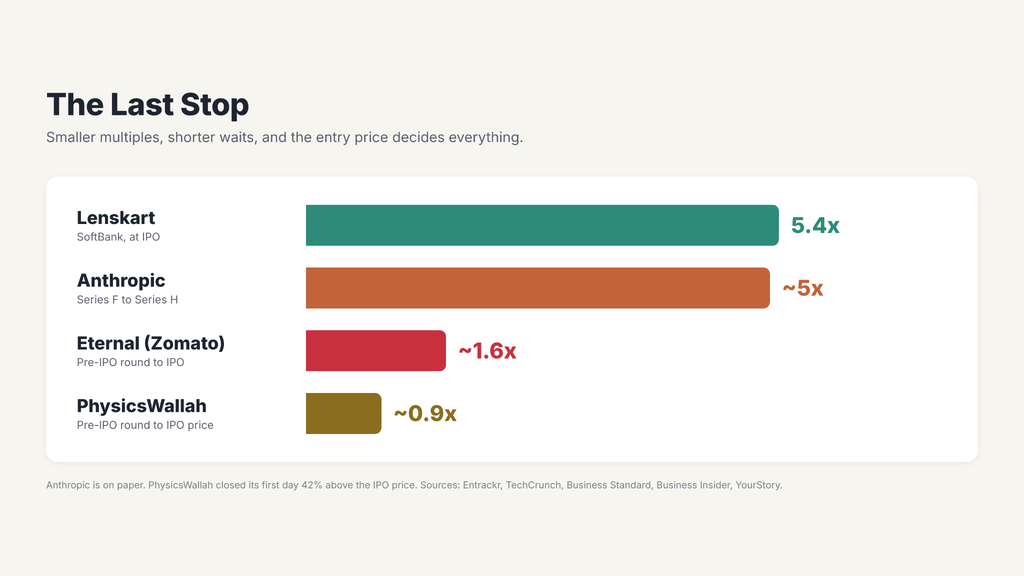
b) Growth Stage:
- Series C+: The valuation already prices in much of the future success, but liquidity is still distant. The “messy middle” of the bar.
- Pre-IPO: A proven business with a visible path to listing. Smaller upside, but the investor is paid in time.
Auxano: Loading Both Ends of the Bar
At Auxano, the barbell is the shape our portfolio as we followed where we believe the risk-reward is best
- Our first fund backs companies at the early stages (in many cases as one of their first institutional investors). Since 2020, it has invested in 15+companies, several of which have scaled meaningfully over the last 3-6 years. At this end of the bar, our job is to catch them young: founders building in the megatrends we have written about before ([e.g. hyperlocal delivery, drone services, AI-enabled content, private market intelligence]), at a stage when the company has little more than the team and the problem it is solving.
- Our second fund invests in late-stage companies with proven business models and a visible path to liquidity. To date, it has invested in 9 companies, including 4 pre-IPO companies. Here, the questions are different. Is the price leaving room for a public market discount? Is the path to listing actually visible, or just hoped for? And is the company’s governance ready for public scrutiny (a theme we covered in an earlier blog)?
The strategy thus follows the classic pattern of barbell investing
- The early end gives us asymmetry: in Extremistan, a few companies can return a multiple of the entire fund.
- The late end gives us visibility and time: a shorter, more predictable road to distributions (DPI) for our investors.
- The middle is where we hold the bar, not where we load it: [e.g. we participate in growth rounds selectively, mostly as follow-ons in our own portfolio].
Takeaway
The bell curve is a comfortable way to see the world, but venture capital does not live in Mediocristan. The average outcome is a number the data rarely visits, and the returns that matter tend to arrive at the two ends: with those who back a company before anyone else believes in it, and with those who join just before the last stop and are paid in speed and certainty.
The middle is where an investor can end up paying a late-stage price for early-stage uncertainty. As Taleb would put it, the barbell is not about eliminating risk, it is about being positioned so that one can benefit when it shows up.
Author
Aditya Golani