

A startup approaches an investor for funding…
The founder presents the business plan, revenue projections and the opportunity to enter a growing market.
The company’s revenue has doubled over the past few years, and the founder is confident about its next stage of growth…
At first glance, it looks like a promising investment, but before reaching a decision, an investor asks a few more questions –
- How much did the company spend to generate this revenue? (Customer Acquisition Cost & Burn)
- How many customers have returned? (Repeat customers)
- How much money has actually been collected? (Cash realisation)
- What is the current cash balance, and how long can the company operate with it? (Cash Runway)
The answers may change the discussion.
The revenue has doubled, but marketing expenditure has also increased. A significant part of the sales remains uncollected, and the company needs another round of funding to support its expansion.
So, is this a business ready to scale, or one that needs to address its economics before growing further?
This is where the familiar question of the glass half full or half empty becomes relevant. One investor sees growth; another sees cash being consumed. Both have a point, but neither view alone is enough. The real investment judgement begins with understanding what is driving the business…
The number is visible. The reason behind it matters.
Financial numbers are often the starting point of an investment discussion. Revenue, profit and cash flow tell us different parts of a business story..
- Revenue tells us what the company has sold/service provided.
- Profit tells us what remains after expenses.
- Cash flow tells us what money has actually moved into and out of the business.
Consider two companies with the same revenue. The first has repeat customers, collects payments within 30 days and generates positive operating cash flow. The second relies on discounts, offers 90-day credit and needs additional working capital to maintain the same sales.
Which business would be the better opportunity?
There is no one-size-fits-all answer. It depends on the market, the business model and the evidence in hand.
However, the comparison makes one thing clear – what you see on the surface does not always tell you what is really going on underneath.
Substance matters more than first impressions
In accounting, the principle of substance over form reminds us to look at the economic reality behind a transaction, not just how it appears in documents. The same thinking applies to investment decisions
- A sale recorded in the books does not, by itself, tell us whether the customer will pay on time.
- A growth plan does not tell us whether its assumptions are realistic.
This is why investors examine financial records, contracts, statutory filings and business operations during due diligence. The purpose is not to question every number, but to understand what it represents
The other side is not always wrong
Looking beyond appearances does not mean doubting every opportunity.
Early-stage businesses operate in uncertain markets and may report losses while building technology, establishing distribution or acquiring customers. Such expenditure may be necessary to create a business that can grow over time..
Equally, a company that looks profitable today may struggle to grow without a lot of extra capital.
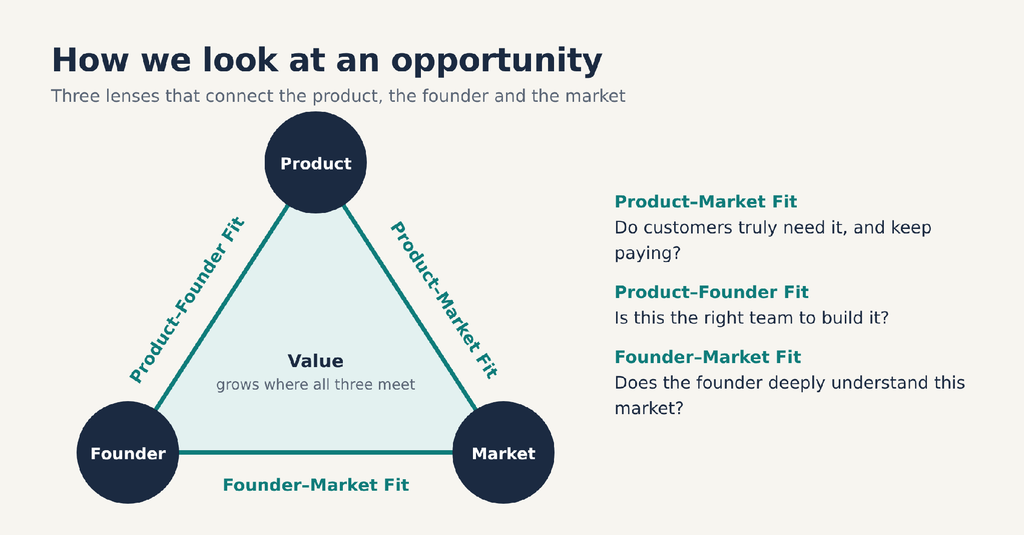
At Auxano, when assessing opportunities in emerging megatrends, we look at Product-Market Fit, Product-Founder Fit and Founder-Market Fit.
Together, these help us connect the product and the founder with the market, the company’s ability to grow, and its potential to create value.
Way forward
In venture capital, optimism helps us recognise possibilities, while evidence helps us test them.
A growing market does not guarantee a successful business, and a loss today does not necessarily make an investment unattractive. Financial results, too, need to be understood in the context of how the business operates.
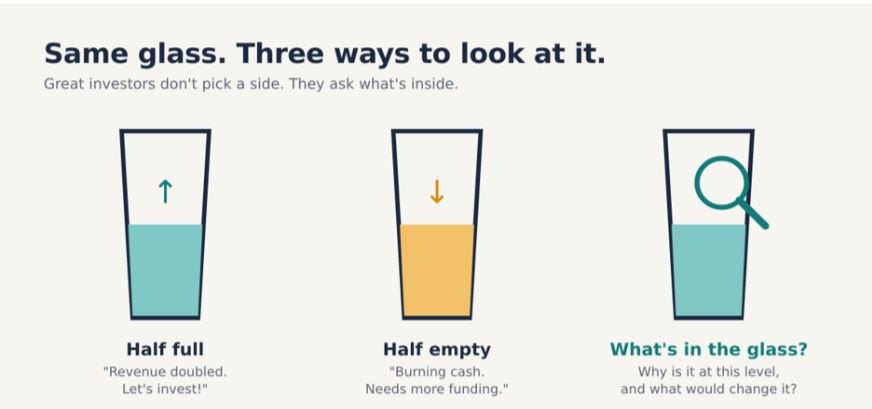
So maybe the better question is not whether the glass is half full or half empty. It is whether we understand what is in the glass, why it is at that level, and what would have to change for us to see it differently.
That is where perspective turns into judgement, and judgement leads to better investment decisions.
Author,
Rakesh Rana