

A shopkeeper has a simple way of measuring his business – at the end of the day, he looks at the cash in the -drawer.
Over the years, the shop becomes bigger, more customers walk in, more products are sold and the daily sales number keeps increasing.
The shopkeeper is happy. One day, someone asks him a simple question:
“Your sales have grown but has your business become more valuable?”
The question changes the conversation.
Because selling more does not always mean earning more. Earning more does not always mean generating more cash and generating cash does not, by itself, tell us whether the business is creating value for the capital invested in it.
Same also applies for startups…
In venture capital, growth is often the most visible part of the story. Revenue, customers, funding rounds and market expansion are easy to measure but behind every growth number is another set of questions:
- What did it cost to create that growth ? (how much spent to earn Rs. 1)
- Is the business becoming more profitable and efficient as it grows?
- How much cash did it consume? (working capital requirement)
- And what is that growth ultimately building?
Revenue is where the story starts
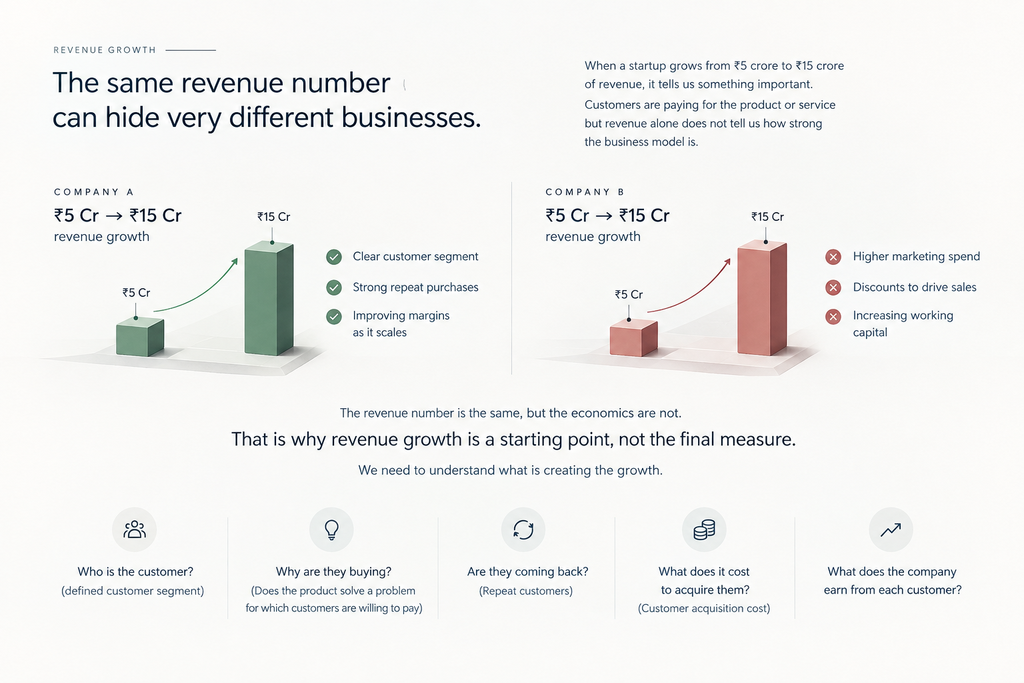
For example – when a startup grows from ₹5 crore to ₹15 crore of revenue, it tells us something important. Customers are paying for the product or service but revenue alone does not tell us how strong the business model is.
Two companies can both grow from ₹5 crore to ₹15 crore and still be building very different businesses.
One may have found a clear customer segment, strong repeat purchases and improving margins as it scales. The other may be achieving the same growth through higher marketing spend, discounts and increasing working capital.
The revenue number is the same, but the economics are not.
That is why revenue growth is a starting point, not the final measure.
We need to understand what is creating the growth.
- Who is the customer? (defined customer segment)
- Why are they buying? (Does the product solve a problem for which customers are willing to pay)
- Are they coming back? (Repeat customers)
- What does it cost to acquire them? (Customer acquisition cost)
- What does the company earn from each customer?
Profit tells us about the economics
Revenue growth tells us that the business is selling more but selling more is not enough. The important question is whether each additional rupee of revenue is making the business economically better.
If a company generates e.g. ₹10 crore of revenue and spends ₹8 crore to run the business, there is something left after the costs.
Therefore, the question is not simply “Is the company profitable?” It is “Is the business model becoming more profitable as it scales?
Revenue shows the size of the business. Margins show the quality of that revenue. Profit shows what remains after running the business.
That is particularly relevant in venture capital, where the investment is often made before the business reaches its mature economics.
Profit is still not cash
Better economics do not automatically mean more money in the bank.
Suppose a company has ₹10 crore of revenue and ₹1 crore of profit – It looks profitable.
But if customers are taking 90 days to pay, while salaries and suppliers have to be paid today, the company may still be short of cash.
The profit exists in the accounts. The cash may not yet exist in the bank, that is why cash flow matters.
Cash gives a company the ability to continue operating, invest in the next stage and manage changes in the business.
For a startup, it also tells us how dependent the business is on external capital.
A company can grow rapidly, but if every stage of growth requires another round of funding just to keep the business running, the quality of that growth needs to be understood.
Auxano Approach
At Auxano, the assessment of a business does not begin and end with revenue.
Our investment thesis looks at Product-Market Fit, Product-Founder Fit, Founder-Market Fit and the Path to Exit. We also look at where a business is in its growth cycle and whether it has the potential to become a category creator, market creator or market leader.
This means financial numbers are considered together with the business behind them.
Revenue growth has to be understood with customer behaviour. Growth has to be understood with the capital required to achieve it. Margins have to be understood with the cost of scaling. Cash burn has to be understood with the milestones that the capital is expected to deliver and the future of the business has to be considered with the path to exit.
This is why the investment question is not simply: How big can this company become?
It is also: What can this growth become?
The assessment continues after the investment
The investment is not the end of the process.
It is the beginning of another phase of working with the business.
At Auxano, portfolio companies are engaged through regular business reviews covering revenue, expenses, cash and bank positions, KPIs, milestones, business plans and projections. Strategic decisions and business requirements are also discussed where relevant.
The purpose is not to run the company. Founder builds the business.
The investor’s role is to remain engaged, understand what is changing and help the founder think through the next stage.
Way forward
There is a simple way to look at the journey: from growth to value
Revenue → Economics → Profitability → Cash → Reinvestment → Value
Every business will move through this journey differently.
Some businesses may remain loss-making while they build their market. Some may generate cash early. Some may need multiple rounds of capital before reaching profitability.
There is no single number that can define whether the business is working.
What matters is understanding the connection between the numbers.
- Revenue proves customer demand.
- Margins prove structural viability.
- Cash guarantees operational independence.
- Durable Value reflects the ability to generate long-term economic returns on invested capital.
For a VC, this is the difference between funding growth and funding value creation.
Growth becomes value when the business can convert capital into better economics, better economics into cash, and cash into the next stage of the business.
That is what lies between revenue and returns.
Author,
Rakesh Rana