
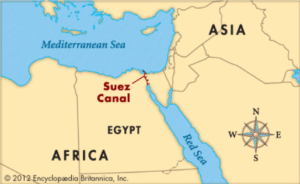
In 1956, Egypt nationalised the Suez Canal, triggering a crisis that involved Britain, France, and Israel. The canal itself is only 193 kilometres long, but at the time it carried roughly two-thirds of Europe’s oil imports. When the route was blocked, ships had to reroute around the Cape of Good Hope, adding 6,000 kilometres and nearly two weeks to each voyage. Oil prices spiked, rationing returned to parts of Europe, and a waterway that most people had never thought about became the centre of global commerce.
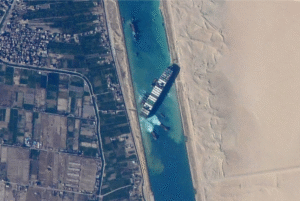
The same pattern repeated in March 2021, when the Ever Given, a 400-metre container ship, ran aground and blocked the canal for six days. An estimated $9.6 billion of trade was held up per day. The lesson was clear – one single obstruction/blockade (ship) was enough to bring an entire process (global supply chain) to a halt.
The Science of the Squeeze
The word “bottleneck” obviously comes from the actual neck of a bottle, and the design is not accidental. A wine bottle’s narrow neck slows oxidation by limiting the surface area exposed to air, controls the pour so the liquid does not spill, and creates the seal that lets the cork hold pressure for decades. The same shape that restricts flow is what preserves the contents. A bottle without a neck is just an open jar.
This dual nature, where constriction serves a purpose but also limits throughput, shows up everywhere once you start looking. Case in point, geographic bottlenecks which have shaped trade and conflict for centuries.
- The Strait of Hormuz handles around 20% of global oil flow through a passage that narrows to 33 kilometres at its tightest point and has been the source of major conflict and instability since Feb’26
- Gibraltar controls access between the Atlantic and the Mediterranean across just 13 kilometres of water.
- The Malacca Strait carries a quarter of global trade through a corridor that is 2.7 kilometres wide at its narrowest.
- Closer home, the Siliguri Corridor (often called the “Chicken’s Neck”) is a 22-kilometre wide strip in West Bengal that connects mainland India to its eight north-eastern states; every road, rail line, and pipeline serving a region of 45 million people runs through it.
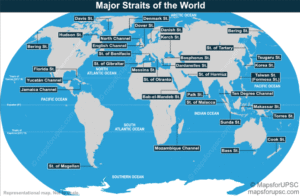
Every major engineering project that followed (the Suez Canal in 1869, the Panama Canal in 1914, the proposed Kra Canal in Thailand) was built to either bypass a chokepoint or create a faster one.
In manufacturing, the Theory of Constraints developed by Eliyahu Goldratt in the 1980s argued that the throughput of any system is determined by its slowest step. A factory that produces 1,000 units in the first stage but only 100 in the final stage is a 100-unit factory, not a 1,000-unit one.
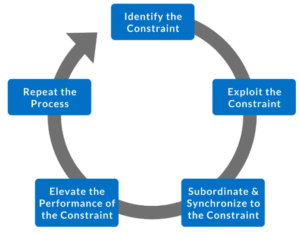
The part that gets missed often is this: if a bottleneck sits in the last 10% of a process, the prior 90% does not matter. The work was done, the time was spent, the cost was incurred, and yet the output is held hostage by the final stage.
- A vaccine that cannot be transported in cold storage does not reach patients.
- A film that cannot clear censor certification does not release.
- A product that cannot pass final QC does not ship.
Where Startups Get Stuck
Founders spend most of their early years building the first 90%. The product gets built, the team gets hired, funds are raised but then the company hits a wall/comes across a bottleneck it did not see coming which has an impact on the entire business. Some examples of bottlenecks include:
- Regulatory clearance that was treated as a formality but turns out to be the gating item for scale (e.g. fintech licences, drone DGCA approvals, medical device certifications).
- Distribution in markets where the product works but the channel to reach customers is owned by someone else (e.g. D2C brands relying solely on one channel like quick commerce platforms).
- Working capital cycles that lengthen as the customer base shifts from SMBs paying upfront to enterprises paying in 90 days.
- Founder bandwidth itself – where the same person is expected to handle product, fundraising, hiring, and key accounts simultaneously.
The companies that fail at this stage are rarely the ones with bad products. They are the ones that built well but did not identify which step would constrain everything else. The 90% looked like progress; the missing 10% was where the value actually got captured or lost.
Auxano: Our Lens
Our approach has always centred on the principle of “Begin with the End in Mind” – first start with the end then work backwards from what is required to get there. This applies both internally in the work we do and across the portfolio.
Internally, we map our own process from sourcing => evaluation => term sheet => diligence => documentation => funds transfer => closure to then portfolio monitoring and support => investor communication => exit and look for where deals slow down.
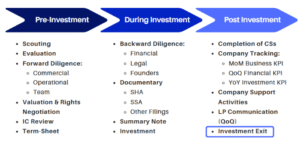
The bottleneck is rarely the part we expected. Sometimes it is legal documentation, sometimes it is reference checks, sometimes it is the back-and-forth on term sheet negotiations. Identifying which step holds up the rest is the first move; updating or restructuring around it is the second.
For portfolio companies, we run a similar exercise during diligence and post-investment. Some of the questions we work through with founders include:
- Which single failure mode would stop the company from reaching the next stage?
- Is the bottleneck a function of capital, capability, or external dependency?
- If solved today, what becomes the next bottleneck?
One more thing to add here is that solving one constraint often leads to another one, and the companies that scale well are the ones that anticipate this rather than react to it. We have seen this play out across our portfolio
- from a logistics company that solved the supply constraint only to find that route optimisation and efficiency is a larger bottleneck
- to a content platform that fixed content creation and production and then had to solve for the last step i.e. distribution and monetisation.
Our role in all such scenarios is not to solve these, but rather make sure that the right question are being asked, and asked early enough to act on them.
Takeaway
The last 10% is where most of the value is realised, and most of the failure happens. Whether it is a wine bottle, a strait, a factory line, or a startup, the throughput of the system is set by its narrowest point – and the narrowness usually exists for a reason.
Identifying that point early, and treating it with the same seriousness as the rest of the build, is what separates companies that breakthrough from companies that remain stagnant.
Author
Aditya Golani