
In 1930, the first World Cup almost did not happen. FIFA had 41 member nations, and only 13 turned up given the long journey to the host country Uruguay. The tournament was handed to them for two reasons:
- the country was marking 100 years of independence, and
- Its team had won back-to-back Olympic golds in 1924 and 1928.
FIFA itself was on all accounts an up and coming ‘startup’-
- The tournament trophy was carried by FIFA’s president, Jules Rimet, personally across the Atlantic in his suitcase.
- The host stadium (Estadio Centenario) was delayed by rain and was not ready until five days into the tournament, so the early matches were squeezed into two smaller grounds.
Despite all of it, ‘the beautiful game’ was played and the host nation Uruguay beat Argentina 4-2 to win the inaugural edition. The ‘world cup fever’ was so high that the next day was declared a national holiday in Uruguay and Argentina cut diplomatic ties with Uruguay. A competition that had nearly collapsed before kickoff had, within three weeks, become something nations were willing to fall out over.
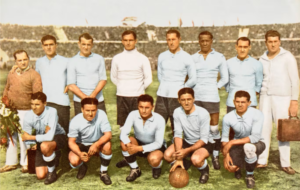
A Snapshot of the winning Uruguay team from the 1930 World Cup Final (Source)
The Evolution of the Game: From Instinct to Infrastructure
That improvised tournament set a template the sport spent the next century scaling into a $13Bn sporting league in 2026 with revenue streams spanning –
- TV Broadcasting: This includes the right to air the matches to networks region by region.
- Hospitality & Ticketing: Match tickets plus premium corporate packages, (via a FIFA-owned subsidiary) with the 2026 World Cup being the first with dynamic, demand-based pricing.
- Marketing & Sponsorship: Brands like Coca-Cola, Visa, and Adidas pay to attach their name to the tournament, sold in tiers from global partners down to regional supporters.
- Licensing: FIFA-branded merchandise, video games, and royalties on the FIFA name.
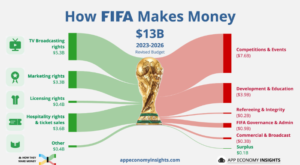
(Source)
The game itself has also been rebuilt around measurement. For most of its history, decisions on the pitch were made by the human eye and argued about afterwards. That changed in stages.
- Goal-line technology arrived in 2014 to settle whether the ball had crossed the line.
- Video review (VAR) came in 2018 to check the referee’s biggest calls.
- Semi-automated offside followed in 2022, tracking limb positions frame by frame, and even
- Specialised sensors directly embedded in balls to track actual gameplay stats
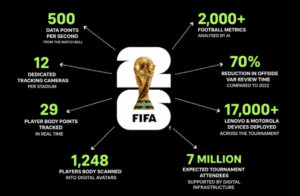
Inset: How Data and Technology are Shaping the FIFA World Cup 2026 (Source)
The sport moved from instinct to evidence and the teams that understood this shift – of where the sport is moving and not just where it is today gained an edge before it became standard. The cost of misreading that is also evident, perhaps no better than in the case of India’s own football history.
- Although India qualified for the 1950 World Cup in Brazil, the team ultimately withdrew. Contrary to the myth that FIFA banned them for playing barefoot, the decision was actually driven by financial constraints, limited preparation time, and the federation’s strategic choice to prioritize the Olympics over what they then viewed as a less significant tournament.
- This isn’t to say that the team did not have the capability to perform at the highest level
- They won 4th Place in the 1956 Melbourne Olympics
- Finished as Runners-up in the 1964 AFC Asian Cup and perhaps most famously,
- Won the 1962 Asian Games against South Korea (the movie Maidaan is based on this story)
This suggests that while talent, skill and processes are in place, there is no proper long-term system of getting and winning the football world cup.
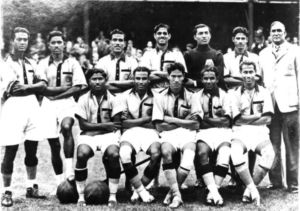
Inset: The Indian football team at the 1948 Olympics (Source)
Anticipating the Play: How Underdogs Win on Untested Turf
The access to new technology and better information would perhaps suggest that the favourites are expected to win most if not all of the time, given they can capitalise on this effectively, yet in football often the opposite happens.
- In 2002, Senegal beat defending champions France 1-0 in the opening match, then reached the quarter-finals on their first appearance.
- In 2018, Croatia, with a population of nearly 4 Mn, reached the finals for the first time.
- In 2022, Morocco knocked out Spain and Portugal to become the first African and first Arab nation in a World Cup semi-final, built on a defensive block that frustrated teams with five times their budget.
None of these sides had the deepest talent pool or the largest federation. They won by setting up for where the game was heading rather than where the status quo was at be it
- a defender marking the space the striker has not run into yet
- Or a manager picking a formation built for one specific tactic/player rather than for the cameras.
Investing works the same way – the consensus sectors are priced like favourites. Obvious bets command obvious valuations, and the return is already spoken for. Real money is made by reading the run early, by backing the team or the shift before the rest of the field turns to look. Spacetech is a live example of this
- For decades, space in India meant ISRO and nobody else. While they continue to see success across missions (some even completed at a lower cost than a Hollywood movie), when the government opened the sector to private companies in 2020, there was no space policy yet, no defined path to an exit, and very little domestic capital willing to wait out a launch programme that runs close to a decade before its first orbital flight. By early 2026, India has more than 300 private space firms building for the future of Indian spacetech solving everything from SAR imaging to even data centers in space.
- Similarly, when SpaceX began with the thesis and goal of landing and reusing rockets, the settled view was that launch was a business for entities like NASA which was loss making and it would be difficult to build entirely reusable rockets. Fast forward to today, SpaceX is now the largest space focused company with a valuation upwards of $2 Tn.
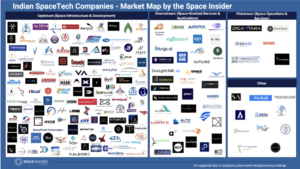
Indian SpaceTech Market Map (Source)
Auxano Lens: Combining the Horse and the Jockey
At Auxano, we have built our approach around emerging megatrends – structural shifts that compound over a five-to-seven-year horizon and create demand for a category of solution that barely exists at the start.
This is done by focusing on both the horse and jockey
- The jockey is the founding team and the motivation and principles that drives them to work on a specific problem
- The horse is the business, the idea or the problem statement that the founding team works on
Both are equally important for a business to scale meaningfully. For each investment, we then work through a series of questions to decide on whether to invest or not:
- Does the founding team understand the problem at the level of the person who lives with it?
- Is the revenue model built to survive conditions the market has not tested yet?
- Is the company positioned to grow as the trend matures, or to peak early?
This is why we entered spaces before they were consensus: hyperlocal delivery, drone services, AI-enabled content production, data privacy, and private market intelligence.
In most of those, the established players were still watching the ball, not the space it was moving into since being early is uncomfortable and can sometimes end up being wrong – but that is where the opportunity to create value exists before the rest of the players catch up.
Takeaway
The favourites win most World Cups, and the safe markets provide for the best investments will continue to be consensus views. But the moments that decide a tournament, and the investments that decide a fund, come from the side nobody priced correctly. The edge is not just better information. It is reading the direction of travel early and committing before the rest of the field turns to look.
Author
Aditya Golani