
What if the greatest discovery in human history is still underwater, waiting, because we decided another planet was more worth exploring?
NASA has charted almost the entirety of the Martian surface at resolutions fine enough to spot a landed rover from orbit. Meanwhile, over 80% of Earth’s ocean floor, three hours from most coastlines, remains unmapped and unexplored.
In 1977, a submersible called Alvin dove 2,500 meters into the Galápagos Rift expecting barren rock. It found life, an entire ecosystem running without a single ray of sunlight. A century-old assumption collapsed in one dive.
Nobody was looking for that. They found it because they followed signals that didn’t match the expected terrain, and kept going anyway.
At Auxano, we’ve built around that same instinct, backing startups like Aereo, before drones had a venture narrative and WIOM, before rural connectivity had a category. No comparable. No consensus. Just terrain signals pointing somewhere real before anyone else thought to look.
The map didn’t say to. The terrain did.
This piece is about how we read it.
The Map Is Always Late
Every investable space eventually gets a name, a market-size slide, and a McKinsey report with a hockey-stick chart. By the time that happens, the space is priced. The analysts are right about the size of the opportunity and mostly irrelevant to the returns, because the founders and funds who mattered were already three years deep before the category had a name to Google.
SaaS didn’t have a name when the first browser-delivered CRM shipped. “Direct-to-consumer” wasn’t a term anyone used until after Warby Parker and Dollar Shave Club had already proven the model. Reusable rockets were, by consensus, a NASA-scale money pit right up until they weren’t.
The map is always late. The return lives in the gap between when a space becomes real and when it becomes nameable. The entire job of an early-stage investor is to operate productively inside that gap, which means learning to read terrain instead of waiting for the map.
Reading the Terrain
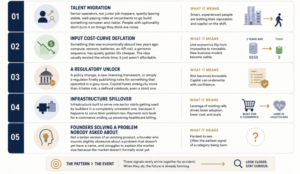
None of these, individually, is proof. Together, they’re a pattern, the equivalent of Alvin’s temperature anomaly. When two or three stack in the same direction, at Auxano, that’s when we move closer.
- Talent migration. Senior operators, not junior job-hoppers, quietly leaving stable, well-paying roles at incumbents to go build something narrower and riskier.
- Input cost-curve deflation. Something that was economically absurd two years ago: compute, sensors, batteries, an API call, a genomic sequence, has quietly gotten 10x cheaper.
- A regulatory unlock. A policy change, a new licensing framework, or simply a regulator finally publishing rules for something that operated in a grey zone. Capital hates ambiguity more than it hates risk, a defined rulebook, even a strict one.
- Infrastructure spillover. Infrastructure built to serve one sector starts getting used by builders in a completely unrelated one, because it happens to solve their problem too. Payment rails built for e-commerce ending up powering healthcare billing.
- Founders solving a problem nobody asked about. Not a better version of an existing product, a founder who sounds slightly obsessive about a problem that doesn’t yet have a name, and struggles to explain the market size because the market doesn’t formally exist yet. This is the least legible signal and the one that matters most.
Space vs. Fad: The Filter That Actually Matters
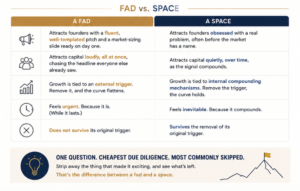
Reading terrain gets you candidates, not conviction. The expensive mistake is confusing a fad for a space because fads produce all the same early noise: capital rushing in, headlines, unicorn rounds, founders with genuinely good pitches.
Indian edtech in 2020 looked exactly like a space. Capital, growth, urgency, a pandemic-sized tailwind. What it actually was: a fad riding a temporary, externally forced behavior change. The moment lockdowns ended, growth curves that looked structural turned out to be borrowed. The Thrasio-style aggregator wave showed a similar pattern, a business model transplanted from a US market without checking whether the underlying structural conditions actually transferred.
At Auxano, we’ve seen this up close. The filter we keep coming back to is one question: strip away the single most exciting number in the pitch, the tailwind, the growth curve, the “unprecedented” moment, and ask what’s left.
A space survives that removal. A fad doesn’t, because the trigger was the business.
A fad attracts founders with fluent, well-templated pitches and market-sizing slides ready on day one. It attracts capital loudly, all at once, chasing the headline everyone already saw. At Auxano, we call it the strip-the-tailwind test. It’s the cheapest due diligence question that exists and the most expensive one to skip.
Auxano Lens: How We Actually Map a Space
Terrain-reading isn’t a philosophy we apply after a deal lands on the table, it happens well before that, on a cadence, independent of any single pitch. Mapping a space at Auxano runs in three stages, moving from wide and informal to narrow and rigorous.
- The watchlist. We maintain a running list of structural shifts, updated quarterly, that sits upstream of any specific company. The five terrain signals are used here not as a checklist against a pitch deck, but as prompts for: what’s changing that most people haven’t priced in yet? A space can sit on this watchlist for several quarters before a single deal against it is evaluated.
- The network as radar, not the internet as radar. Reports and headlines are, by definition, lagging. If it’s written up, it’s already priced. Our earliest signal instead comes from the people already inside a space before it has a name: our own portfolio founders (who see supplier shifts, hiring patterns, and customer pull long before we do), domain operators and advisors we speak with specifically to pressure-test a thesis, and the pattern across our own deal funnel itself. We see well over 450+ opportunities a quarter; when a cluster of unrelated founders start independently describing the same underlying problem, in different words, that clustering is itself a signal, often a stronger one than any single founder’s pitch.
- The scorecard. A space graduating from watchlist to active thesis still clears our formal 17-parameter evaluation problem validation, market, team, moat. The difference: a company entering from a mapped space gets evaluated against the thesis first, the deck second.
The output is deliberately narrow. Most quarters, the watchlist adds one or two genuine candidates and drops several that failed to compound once we looked closer.
Before it’s on the Map
Odysseus spent ten years finding his way home across a sea with no reliable map. The sailors who made it weren’t waiting for a confirmed route, they read what the sea gave them: a bird’s flight path meant land was near, a shift in the water’s color meant a current was turning. The map, when one existed, was drawn after someone made the crossing never before. By the time a space has a market-sizing slide, a conference track, and a name everyone agrees on, the map has caught up and the return has mostly already been priced in.
At Auxano, we don’t predict the future. We notice it, earlier than consensus, in the patches of unmapped terrain that are already showing the right signal. And we have the discipline to walk away from the ones that are just loud.
That’s not a framework. It’s the only way we know how to move.
Author,
Kushagra Sharma