

104 matches, 48 teams, 308 goals, 266 yellow cards, 15 red cards, 4 penalty shootouts and 6.8 million attendees across the tournament. By all accounts the FIFA World Cup was one of the biggest sporting events this year, with a projected revenue of $8.9 Bn from the 2026 edition.
In one of our previous blog – we discussed the journey of the World Cup, the increasing role of technology across the tournament and how spotting megatrends before the consensus requires going against the grain. The tournament has since ended, but in true analytical fashion, there’s a lot that the numbers tell us about the beautiful game, proving again that there is no permanent status quo and the ‘times are a changing’
- Cape Verde, one of the smallest countries at the worldcup (population < 600K), had one of the best performances in recent years, going toe to toe against heavyweights like Argentina and even drawing with the eventual champions Spain. Conversely, only 8 countries have won the World Cup since its inception.
- On the other hand, Spain defeated Argentina – securing victory sixteen years after the first one, having executed over twenty shots (vs Argentina’s 0) and finally scoring in the 106th minute. In contrast, Argentina’s goalkeeper made eleven saves, the highest in a World Cup final till date.
- The tournament in 2026 averaged 2.96 goals per match, establishing a record for goals since 1970 but this number was led largely by the 3rd place match between England and France which had a final score of 6-4. Conversely, the final between Spain and Argentina yielded zero goals until minute 106.
- Spain now holds titles for men and women simultaneously (the first in the world) and also had one of the most unique demographics – their Manager Luis de la Fuente achieved victory at age 65 (oldest manager), with players like Lamine Yamal and Pau Cubarsí being only the 4th and 5th teenagers to win a World Cup final, joining the likes of Pelé and Mbappé.

Source (Link)
That’s the thing about numbers, on their own they are just a value, but with the right narrative – they become a fact or an argument that is difficult to ignore. The World Cup gives several such numbers, with every stakeholder deriving their own inferences and ultimately value from them independently.
The Math Behind the Number
There’s an old saying that ‘Numbers don’t lie’ – after all, numbers usually carry an authority the reasoning behind them rarely earns, but the underlying rationale or ‘why’ behind particular numbers can often give more information than the numbers itself.
Take Benford’s Law – across most naturally occurring datasets such as river lengths, electricity bills, market caps the leading digit is not evenly distributed.
- About 30% of entries start with a 1.
- Under 5% start with a 9.
- The pattern holds across currencies, company sizes, and census data, reliably enough that forensic accountants use deviations from it to flag manipulated books.
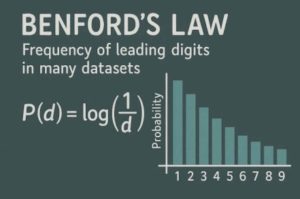
The pattern is useful because deviations can flag possible manipulation. Auditors and forensic analysts use Benford-style tests as a screening tool when financial records look “too neat” or structurally unusual including high-profile cases such as Enron, and in public finance contexts (such as Greece before they declared bankruptcy) where reported numbers later drew scrutiny.
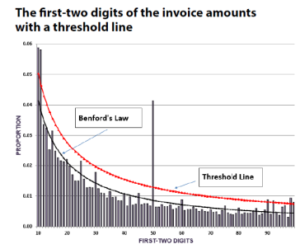
Inset: Application of Benford’s Law in Detecting Invoice Regularities (Source)
Valuation lives in the same territory, minus the forensic tools
Aswath Damodaran, whose Musings on Markets and Narrative and Numbers remain the most useful public writing on this makes the point directly: a valuation is a story with numbers stapled to it. A DCF looks precise to four decimal places, but the entire output rests on three or four assumptions doing all the work:
- Revenue growth
- Margin at maturity
- Reinvestment rate
- Cost of capital
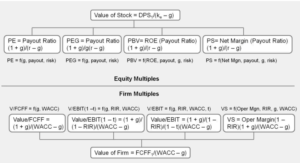
Shift the terminal growth rate by one percentage point and the value can move by a third. The model isn’t obscuring the results but rather amplifying whatever story influenced the inputs that went into it that can often result in GIGO (Garbage In Garbage Out).
Pricing vs Valuing: The Startup Lens
For startups, the distinction sharpens. Most early rounds are not valued at all. They are priced.
The sequence usually runs backwards from what founders expect:
- The company decides how much capital it needs for the next 18–24 months.
- The investor works to a target ownership, commonly 10–20% depending on stage and fund size.
- The valuation is whatever number reconciles the two.
A $2Mn raise against a 20% target produces a $10Mn post-money, without any rigorous DCF modelling.
What changes across stages is the evidence supporting the story.
- Pre-seed and seed: team, problem, market. Comparables are directional at best.
- Series A and B: revenue multiples, retention, payback periods. The story now has to survive two years of data.
- Growth: cash flow, unit economics, and a path to an exit value that clears the fund’s return requirement.
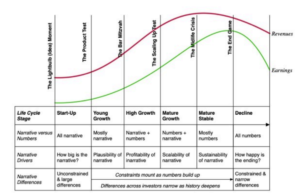
The Company Lifecycle and Valuation Framework by Aswath Damodaran (Source)
Incentives also differ by stakeholder and their priorities
- A founder optimises for minimum dilution and maximum valuation of their and their team’s equity
- An investor optimises for ownership at entry and the ability to hold it through later rounds with minimal dilution
- A banker optimises for the highest defensible number, and can usually assemble a comparable set that supports it.
All three can be right while looking at the same spreadsheet.
The risk sits in the round after. A valuation set well ahead of the business creates a gap the next 18 months have to close. If it does not, the following round is flat or down, ESOP pools get repriced, preference terms harden, and the cap table stops working for the people still building.
Auxano Lens: Rightsizing Both Sides
At Auxano, we treat valuation and round size as one decision, not two. The question we work through with founders is not “what can this company command” but “what does this company need, and what does that price commit it to.”
- A round that is too small forces a raise before the milestones land.
- A round too large at too high a price dilutes early and sets a bar the business may not clear in time.
The tension is that a high valuation feels like a win in the moment. It dilutes the founder less and makes a better announcement. But price is a promise. Every rupee of valuation today is a milestone the company has to hit before the next round, or the next round is flat or down – and a down round costs far more in signalling, morale, and repriced ESOP than the founder saved in dilution the first time. This shows up at every point of the relationship:
- First call: a founder mentioned a different round size and/or valuation to what was mentioned earlier (can be because of higher capital requirements => same dilution => larger round and)
- Term sheet: typically the round and valuation get fixed here for the share price calculation later (for a priced/preference share round, for debentures a floor & cap approach is used) this is where the maximum amount of time is spent on the valuation discussion (we also structure this alongside the rights and other provisions in the term sheet to ensure the remaining transaction process goes smoothly)
- First cheque: In case of a tranche wise/milestone based allocation, founders often suggest revising the valuation for later tranches indicating the milestones or progress the business has made in that duration.
- Follow-on: The question at this stage often is whether one should double down in a company or not, especially in edge cases, two examples come to mind
- Downround: one of our portfolio companies did a down round in 2021 to raise capital else they would cease to exist. Despite the dilution impact and lower valuation, we continued to back the company and the vision. Fast forward to today, they have scaled significantly since then and raised a larger Series B round, wherein the investors who invested prior to 2021 got an exit at a lower multiples, whereas those who invested in the down round got higher multiples. The question here is not just on the ‘numbers’ (valuation) but rather more quintessential – i.e whether to invest at lower terms and get lower returns or not participate and the company shuts down.
- Complete Business Pivot: One other portfolio that operated in the software and services space and after operating in the space for a few years, decided to pivot to a pure play hardware play. Despite the inherent difference and challenges in a software vs hardware business, the company pivoted, realising their vision of an integrated computing platform scaling 7x in the last 3 years and now building with an agentic first approach.
- Exit: Another company from our portfolio had raised funding in 2025 and has continued to scale in a mature/stable business segment and are now looking to do a larger capital raise via an IPO route in the coming years, ensuring that the valuation is beneficial not only to the promoters but also the investors and early backers
The pattern is consistent. We would rather price a round so the next one is a step up earned by the business, than agree to a number that reads well in the announcement and creates a problem four quarters later.
Takeaway
Every valuation is a story converted into a number. The conversion hides the assumptions, and the assumptions are where the disagreement actually lives. Ask what has to be true for the number to hold.
Rightsizing matters more than maximising. The valuation that helps a company is the one that funds the next set of milestones and leaves room for the round after it.
And the first number in the room does more work than anyone admits. Know where it came from before you agree to it.
Author,
Aditya Golani