
Imagine a teenager on a skateboard waiting at a stop sign. A large delivery truck slowly pulls up. As the truck begins to accelerate, the skateboarder reaches out and grabs the back bumper. The teenager has no intention of getting inside the truck or following its delivery route. Instead, he simply holds on just long enough to let the truck’s powerful engine pull him forward, rapidly building up the speed. Once they are going fast enough, he lets go, using that stolen momentum to launch himself down a completely different street.
He didn’t want a ride; he just wanted a boost.
In aerospace engineering, this exact same concept is used to explore the universe. It is called a gravity assist, or a gravitational slingshot. When a space agency wants to send a probe to the outer edges of the solar system, they don’t carry enough fuel to get there directly. Instead, they aim the spacecraft at a massive planet like Jupiter. The probe flies close enough to get caught in Jupiter’s immense gravitational pull, swinging around the planet and stealing a tiny fraction of its orbital momentum. It acts exactly like the skateboarder grabbing the truck. The spacecraft gains a massive boost in speed and slingshots out into deep space toward its actual destination, leaving the planet behind as a mere temporary stepping stone.
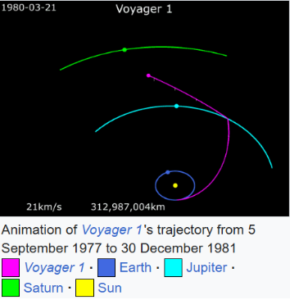
For a space probe like Voyager, this maneuver is a stroke of engineering genius. It is efficient and entirely necessary for survival in the vastness of space. However, when this exact same “slingshot” dynamic is applied to human relationships, specifically in the high-stakes world of venture capital, it feels contrary.
In the VC ecosystem, we often encounter founders who are looking for the right gravitational pull to launch their companies to the next level. Our goal is to be a long-term, stable partner that provides the capital, resources, and gravity needed to build a sustainable business. But every so often, a founder comes along who views a VC firm not as a home, but as a slingshot. They use the momentum of our interest and our initial commitments to propel themselves toward a completely different destination.
This brings me to a recent experience we had, a scenario that mirrors the gravity assist, but leaves a much colder trail.
Shopping and the Silence
As a VC, part of our day-to-day involves looking past the surface to evaluate the true potential of a startup. Recently, a founder shared a promising venture. The startup had traction, a solid product-market fit, and all the early indicators of a highly successful business.
On paper, it was the kind of company one would want to back – a category creator.
However, the deal had a layer of friction initially. The intermediary between Auxano and the founder was an investment banker who left a lot of things unsaid and assumed. If you read one of our previous blogs, you might recall our thoughts on this. He had a habit of muddying the waters rather than clarifying them, and making a complex process even more difficult.
Auxano spent time:
- doing the heavy lifting,
- analyzing the data,
- digging into the core metrics,
- reviewing contracts, and thoroughly vetting the opportunity at the initial stage.
Auxano did the hard work to see the value through the fog created by the banker.
Everything was tracking in the right direction. Auxano was aligned enough that we decided to extend a soft commitment to the founder. Didn’t issue a formal term sheet just yet, but we gave our word that we were interested and would move ahead. In the venture world, a soft commitment is not a casual gesture; it is a strong signal of trust, intent, and a desire to build a partnership.
For a couple weeks, the founder stopped responding to our emails. We waited patiently, assuming they were simply sorting out internal details or dealing with operational bottlenecks.
When the IB came back to us they returned to inform us that they had secured offers from other VC firms, on higher valuations and larger investment amounts. The dynamics of the deal had completely changed.
It became immediately clear what had happened. They had taken our soft commitment and used it as leverage, parading our stamp of approval around the market to negotiate their value and pressure other firms into offering better deals. They went “term sheet shopping”.
In the startup world, we understand that founders want the best possible deal for their company. Seeking competitive offers is a natural part of business. However, using a firm’s good-faith soft commitment purely as a negotiating wedge, especially after we had invested significant time and resources navigating around a poor intermediary to validate their data, crosses a line of professional etiquette.
Just like a spacecraft using a planet for a gravitational slingshot, or a skateboarder grabbing a truck, the founder used our firm’s gravity to build their momentum and launch themselves elsewhere. They got their boost. In an industry as tightly knit as venture capital, trust is the most valuable currency they have. A slingshot maneuver might get you a short-term boost in valuation, but a long-term orbit with a dedicated partner is what actually sustains a company through the unpredictable journey of building a business.
Author,
Tanmay Gajbhiye