
At Auxano, we are highly selective about where we invest. Our approach is grounded in deep due diligence and a deliberate, balanced mapping of rights and obligations across all stakeholders—investors, promoters, ESOP holders, advisors, and others.
This is not a legal obsession; it is a long-term value creation philosophy.
A Concerning Pattern in Late-Stage Pipelines
In recent months, we have reviewed multiple transactions at advanced stages of the pipeline. A recurring pattern stood out, these are not outliers, nor are they criticisms, they are observations from the deal room that may be useful for the ecosystem as it continues to evolve: presence of pre-drafted Shareholders’ Agreements, often presented with the expectation that incoming investors would broadly align with it.
Preparation, of course, is a positive signal. The challenge, however, has been less about having an SHA and more about how rights and obligations flow through it
In several cases:
- Promoter obligations were reduced to near-negligible levels.
- Accountability mechanisms—expected in any investor-backed company—were diluted or missing.
- Investor rights were selectively weakened and often left parts of the cap table with limited protections.
This naturally raises broader questions around alignment. Capital may enter a company through different cheques, but its importance remains the same. Long-term partnerships tend to work best when rights and responsibilities are proportionate, transparent, and evenly understood.
And if investors lack basic protections, why should they invest at all?
The Valuation Vanity Trap
Another subtle shift we have observed relates to valuation perception. Founders raising at ₹100–200 Cr valuations increasingly view this milestone as a point of arrival. In today’s ecosystem, however, such valuations—while commendable—are no longer rare.
It’s time for an honest reality check.
In today’s Indian startup ecosystem, with a decent product and early traction one can scale to a ₹200 Cr valuation with very less friction. A number that once signified scarcity and liquidity has increasingly become vanity.
What has changed:
- These valuations are often not liquid.
- They are rarely convertible to cash at will.
- They do not automatically imply institutional maturity.
When valuation begins to shape self-perception more than operational readiness, it can inadvertently introduce friction—both internally and with stakeholders.
Reflections from the Other Side of the Table
It would be incomplete to view these dynamics solely through a founder lens. Investor behaviour also plays a role.
Disclaimer: these are not universal practices, but patterns observed over a decade in the ecosystem.
1. First-Time and Low-Experience Investors
Investors with less than ~7-10 years of experience often have not seen the full lifecycle of investing—especially downturns, governance failures, or exits gone wrong.
Driven by optimism and founder empathy, they sometimes agree to constructs that have long-term consequences, such as:
- Investor-level ROFRs
- Founder-controlled boards without defined escalation paths
- Absence of exit or clawback mechanisms in extreme scenarios such as fraud, embezzlement, or serious misconduct
These decisions are rarely malicious, but they are often regretted later—by the same investors and others who follow.
2. Founder-Cum-Investors
Founder-investors bring invaluable operating insight and risk appetite into the ecosystem. They play a vital role in recycling capital and experience into the ecosystem.
At the same time, their strategic interests and experience can shape transactions in complex ways. This group also brings its own biases under the banner of being “founder-friendly”, such as:
- Loosen governance guardrails excessively
- Introduce asymmetric exit or strategic clauses favouring themselves
3. Angel Networks and Capital Aggregators
Capital aggregation platforms have significantly expanded access to early-stage funding. Their scale and reach serve an important purpose. That said, models driven by volume can sometimes prioritise speed over structure, especially when they operate with low skin in the game. More often than not,
- They aggregate capital rather than deploy significant proprietary capital.
- Their primary incentive is aggregation or discovery fees.
- Volume often takes precedence over depth—hundreds of deals, thousands of angels.
While this makes business sense for the platform, in the long run it:
- Dilutes governance standards
- Encourages speed over scrutiny
- Pushes risk downstream to fragmented individual investors
The Cost of Collective Amnesia
Every 3–4 years, the ecosystem witnesses governance-led busts.
When they happen, everyone reflects, writes, and promises change.
Then the cycle repeats.
We don’t learn—we apply band-aids.
Once the recovery phase passes, old behaviors resurface, often with greater damage than before.
Rethinking Roles and Responsibility in the Ecosystem
A healthier ecosystem requires clarity of roles—not just legal definitions.
- Institutional investors should be identified not merely by entity structure, but by the extent of fiduciary responsibility, governance capability, and accountability.
- Angel syndicates with 2–3 individuals acting in consortium may legally resemble institutions, but in substance they are proprietary investors.
- Conversely, an angel writing a larger cheque does not automatically gain the capacity to:
- Provide cross-functional strategic input
- Oversee governance
- Safeguard interests of all stakeholders
- Provide cross-functional strategic input
Institutional investors typically bring:
- Dedicated teams
- External advisors
- Domain experts
- Governance frameworks refined over cycles
Promoters are usually open to value-adding inputs—regardless of stake size.
However, when it comes to governance, priority should be given to those who can genuinely shoulder the responsibility, not merely retain control.
Why Governance Is Core to Our Investment Philosophy
Fly-by-night operators inevitably emerge in fast-growing markets. Startups have been one such magnet for over a decade.
The ecosystem has already paid a heavy price—financially and reputationally.
As conscious investors, our contribution is to:
- Share insights
- Call out unhealthy patterns
- Push for durable, fair frameworks
Not to restrict innovation—but to ensure the ecosystem evolves into something robust, credible, and impactful, rather than being periodically dismissed as another speculative bubble.
Governance is not a constraint on growth. It is what allows growth to endure.
Snapshots from the Deal Room
Case 1: The “Prepared SHA” Illusion
Stage: Series A
Valuation: ~₹150 Cr
On closer review:
- Founder obligations were limited to best-effort clauses with no performance linkage.
- No affirmative obligation on founders for information disclosure beyond statutory minimums.
Outcome:
The document looked sophisticated but was structurally unbalanced. Accountability was cosmetic, not enforceable. Investors were expected to fund growth without meaningful oversight.
Lesson:
A pre-drafted SHA often reflects power positioning, not partnership
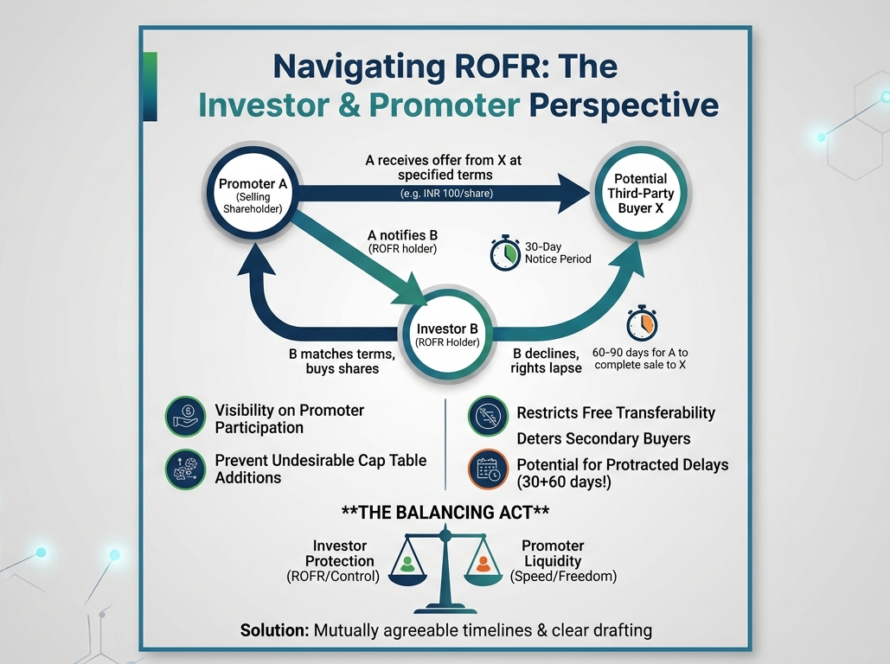
Case 2: ROFR on Investors, ROFO on Founder
Stage: Pre-Series A
Lead: First-time institutional investor
Syndicate: Angels + micro funds
A clause allowed:
- Founder to freely sell shares after a lock-in
- Investors to be bound by ROFR on their own exits
- No reciprocal protection for minority investors
Several investors agreed without questioning downstream impact.
Hidden risk:
This structure can freeze investor liquidity while enabling promoter-led cap table reshuffles.
Lesson:
Optimism is not a substitute for lifecycle experience.
Case 3: Founder-Controlled Board with No Exit Triggers
Stage: Early growth
Board composition: 3 founders, 1 investor observer
Governance construct: “High trust, founder-led culture”
What was missing:
- No mechanism to trigger exit on fraud or fund misuse
- No equity clawback on serious misconduct
- No independent director or escalation framework
Investor rationale:
“We don’t want to demotivate the founder.”
Lesson:
Governance exists precisely for moments when trust breaks—not when it works.
Case 4: Strategic Founder-Investor with IP Call Option
Stage: Series B
Investor profile: Successful exited founder with strategic adjacency
Inserted clause:
- Right to acquire company IP at the end of the investment period
- Vague valuation guardrails
- No requirement for consent from other investors or founders
- Power of Attorney embedded to execute transfer
Despite clear asymmetry, multiple investors signed.
Why?
- Assumption that the lead would protect collective interest
- Inadequate legal review
- Halo effect of the strategic investor
Lesson:
Experience can be weaponised if not counterbalanced by checks.
The Common Thread
Across these cases, the issue is not bad intent.
It is misaligned incentives, shallow scrutiny, and collective complacency.
When:
- Founders overestimate valuation maturity
- Investors underestimate governance risk
- Prioritising speed over structure
…the ecosystem sets itself up for periodic failures.
Closing Thought
These snapshots are not warnings against investing or building.
They are reminders that capital without accountability is not fuel—it is friction.
If we want an ecosystem that compounds trust and value, governance cannot be treated as:
- A legal hurdle
- A founder-unfriendly imposition
- Or a post-facto correction
It must be designed deliberately—before the money is wired.
At Auxano, this belief continues to guide how we engage, evaluate, and partner. We share it here in the hope that it contributes, in some small way, to a more resilient and trusted startup ecosystem.
Author,
Karan Gupta