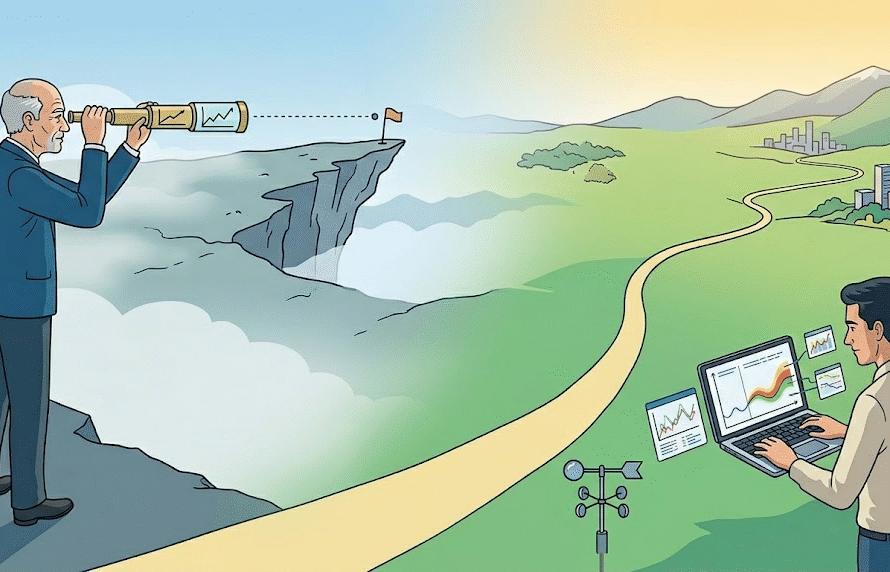

In the previous blog ‘The Evolving Mindset: The Journey from Founder to Business Owners’ we shared our experiences with start-ups and founders evolving into businesses and business owners respectively.
In this blog we will take a step further and explore the approach and pitfalls in the journey of these businesses evolving into institutions and owners into leaders.
As businesses achieve scale and success begins to compound, the business owners face an entirely new set of tests – not of competence, but of character.
As investors, we have observed when business owners mature, something remarkable happens. They start thinking not in terms of valuation, but in terms of value creation. They shift from chasing headlines to building legacies. And these owners, who lead with integrity find themselves backed again and again. Their credibility becomes their collateral, because in the long run, capital rewards capability, but it endures with character.
Let’s look at some of the well known entrepreneurs who built legacies
- Sridhar Vembu – Zoho
In a world obsessed with announcements and valuations, Sridhar Vembu quietly built Zoho into a global SaaS powerhouse from the villages of Tamil Nadu. He rejected the shortcuts of external funding and instead invested in people, teaching rural youth to become world-class engineers. No noise, no frenzy – just an unwavering commitment to culture, craftsmanship, and character. And because trust compounds faster than capital, Zoho became one of India’s most respected technology companies.
- Nithin & Nikhil Kamath — Zerodha
At a time when fintech was defined by burn rates and blitzscaling, the Kamath brothers took a different path. They built Zerodha brick by brick – bootstrapped, profitable, and radically transparent. Instead of buying growth, they earned trust; instead of chasing valuation, they focused on creating a product and culture that could stand the test of time. Today, Zerodha is a leading retail brokerage company not because it shouted the loudest, but because it delivered consistently. It’s a reminder that credibility, when nurtured quietly, becomes a moat no one can replicate.
On the other hand…
The same drive that once pushed the founders to challenge convention can, if unchecked, turn inward.
It can also happen, business owners, after years of relentless struggle, begin to shift their focus – often unconsciously – from building the business to benefiting from it. It may start innocently: a higher salary justified by growth, personal expenses blurred into company accounts, or a parallel venture launch.
But over time, these small actions can snowball into a culture of self-prioritization.
The ecosystem has witnessed:
- Business owners drawing higher salary while the business continues to bleed
- Allocate unreasonable equity to themselves at the cost of dilution of early backers
- Sell secondary stakes prematurely to pocket personal gains while the business continues to fight for stability.
- Engage in related-party transactions or channel opportunities through affiliates for short-term benefit.
These choices begin to erode trust – first among investors, then within teams, and eventually across the ecosystem. Once trust breaks, it rarely returns.
As a result, the owners’ focus shifts from creating value to defending optics, from running the business to managing stakeholders.
What makes this particularly concerning is not the financial impact – capital can recover – but the loss of credibility. In the world we live in, credibility compounds faster than capital and when it is lost, one suffers.
Approach
There is another path – one that a few exceptional LEADERS choose – Building Beyond Business
These are the individuals who, despite access to wealth, remain guided by principles of transparency, fairness, and stewardship.
They see themselves not as owners of a business, but as custodians of a shared enterprise – responsible for employees, customers, shareholders, and the broader ecosystem that enabled the success.
They understand that as visibility grows, every decision becomes a signal – to their teams, to the market, and to the next generation of entrepreneurs. By upholding integrity in times of abundance, they earn the kind of long-term trust that money cannot buy.
This mindset differentiates company builders from institution builders. Company builders create economic value; institution builders create enduring legacy.
The latter are remembered not merely for their valuations or IPO exits, but for the cultures they nurtured and the reputations they sustained.
It is this ethos that made the Tatas and the Birlas household names – not just as business owners, but as stewards of trust. They built enterprises that outlasted markets, cycles, and even themselves.
In today’s ecosystem – often characterized by speed, liquidity, and constant comparison, this kind of patience and integrity may appear old-fashioned. Yet, it remains the single most defining quality of enduring leadership. Because when valuations fluctuate and markets correct, it is trust that holds everything together.
Investor Lens
So while it is natural for a human being to aspire for personal growth and reward, it is essential to balance it with the duty owed to those who walked the journey alongside them – the employees who built, the investors who believed, and the customers who trusted.
In the end, success built without integrity is rarely sustainable. But integrity, when paired with ambition, builds something far greater than companies – it builds character, community, and legacy.
At Auxano, we take pride in partnering with such founders who combine ambition with authenticity, speed with sustainability, and innovation with integrity.
Author
Karan Gupta