

Every city has its landmarks.
People admire skyscrapers for their height, architecture, and design. They take photographs of the completed building, not the months spent digging the ground underneath it.
Yet every structural engineer knows one simple truth—the taller the building, the deeper its foundation. Without that foundation, the building may look impressive for a while, but it will never stand the test of time.
Venture capital operates on the exact same law.
When people talk about venture capital, the conversation usually revolves around founders, funding rounds, unicorns, and exits. Headlines celebrate valuations, successful IPOs and acquisitions. Investors discuss time horizons, returns, and portfolio performance.
Very few people talk about the work that makes all of this possible—
- Structured investment processes (to navigate early-stage uncertainty)
- Active Engagement & Monitoring (to support scaling)
- Governance and Compliance (to maintain fiduciary trust)
These operational pillars rarely make headlines. Yet they form the exact foundation on which the long-term investor confidence is built.
In venture capital, money may be the visible investment. Trust is the real one…
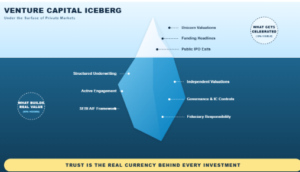
Trust Moves Capital
When investors commit their hard-earned capital to a VC fund to build long-term wealth, they do more than allocating money. They are placing their confidence in the people who will manage that capital.
During that journey, investors will not participate in any investment discussion or portfolio review meetings. They trust the fund manager to evaluate opportunities, manage risks, report portfolio performance and make decisions in the best interests of all stakeholders.
That is why every investment begins with a question that is much bigger than expected returns; can I trust the process behind this fund?
Returns may attract investors; trust keeps them invested.
Regulation Strengthens the Foundation
When SEBI introduced the Alternative Investment Fund (AIF) Regulations in 2012, it laid the groundwork for a mature private capital market. Over time, this framework expanded to include stricter disclosures, standardized valuations, and independent oversight.
Every new compliance update can feel like an added obligation, but its true purpose is much larger: it builds confidence between investors, fund managers, and founders.
The industry’s growth reflects that trust.
Today, India has close to 2,000 registered AIFs with total investor commitments exceeding ₹16.9 lakh crore. This growth is not just about capital availability—it is proof of increasing confidence in the ecosystem’s governance framework.
Recent policy development, National Pension System (NPS) Bharat FoF, a dedicated fund-of-funds structure that allows NPS pension savings to participate in SEBI-registered Category I and II AIFs, reflect this growing confidence in India’s alternative investment ecosystem. As larger institutional capital pools enter the market, governance evolves from a regulatory expectation into the very foundation of fiduciary responsibility…
Regulation does not eliminate business risk. What it does is guarantee that risk is managed with discipline, transparency, and accountability.
Why Governance matters more in Venture Capital
Building an early-stage business is fundamentally different from operating a mature enterprise.
- Markets change
- Products evolve
- Business models are refined.
Some companies grow faster than expected, while others require more time and capital.
Uncertainty is not an exception in venture capital—it is the baseline. That is precisely why governance matters-
- Investment Committees diligently assess, evaluate and approve the investment before capital is deployed.
- Regular review of portfolio companies and reporting maintains complete visibility throughout the fund’s life.
- Independent valuation frameworks ensure companies are marked fairly and consistently.
None of these processes guarantee business success. What they do create is confidence that capital is managed with discipline. That confidence allows investors to stay patient while businesses build real value.
The Auxano Perspective
At Auxano, governance has never been treated as a separate compliance checklist. It is central to how we believe venture capital should operate.
As our journey evolved from Special Purpose Vehicles (SPVs) to institutional Category I and Category II AIF structures, our governance framework evolved with us:
- Our investment processes became more structured – Every investment begins with rigorous evaluation -multiple calls and in-person interactions with founders and core teams before a decision made.
- Investor communication and reporting became more transparent – We share portfolio key business progress on a quarterly basis not just at fundraise or exit.
- Implemented the regulatory changes before the deadlines (including the cybersecurity and digital accessibility requirements mandated by SEBI)
We encourage this same mindset across our portfolio companies from day zero. In fact, founders have often shared that our due diligence process helped them become compliant early on by deepening their understanding of regulatory standards, documentation, and operational processes.
Compliance and governance are not something founders prepare for right before an IPO or a major fundraise. It must be built into the company’s culture from day one.
Compliance is not just a tick-box exercise. It is the bridge through which trust is built, preserved, and compounded over time. In many ways, the return on compliance is the reputation of the organisation.
Way forward-
Capital builds businesses, and trust moves capital.
Money can be transferred in seconds; trust takes years to earn.
Investors do not stay invested with VC fund simply because the portfolio grows. They stay invested because they trust the people managing their money with fiduciary responsibility.
What keeps investors connected isn’t the illiquid nature of the asset class. It’s trust in governance.
In venture capital, that trust is the most valuable currency of all.
Author,
Rakesh Rana