

Probably Right: The Case for Forecasting without Certainty

For most of the twentieth century, sports scouts judged players by intuition and visible metrics such as speed, strength, “coachability”, the same gut-feel signals everyone else used. Predictions were made with confidence and missed with regularity, and yet the methods never changed.
That changed in 2002, when a baseball team quietly abandoned intuition in favour of sabermetrics a statistical framework that prized indicators like on-base percentage (how many times does a player reach base/gets a run) over the glamour stats (such as homeruns) the rest of baseball worshipped. With roughly one-third the payroll of teams like the New York Yankees, Oakland assembled a roster of cast-offs, ripped off a 20-game winning streak, and won the American League West.
That team was Oakland Athletics, led by general manager Billy Beane (the story was later captured in Michael Lewis’s 2003 book Moneyball: The Art of Winning an Unfair Game* and also the 2011 Oscar‑nominated film Moneyball), with many highlighting Beane’s approach as a systematic arbitrage against the biases of the establishment, after which the term “Moneyball” became shorthand for any underdog strategy that replaces gut‑feel with data‑driven decision‑making.
The Error in Every Forecast
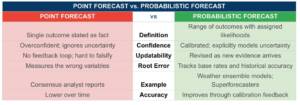
The default mode of prediction is the point forecast: a single number, a specific outcome, a definitive claim. This is also the least reliable mode. Philip Tetlock’s landmark study, later expanded into the book Superforecasting, tracked thousands of predictions by domain experts over two decades. The finding was sobering: experts performed no better than chance on long-range forecasts, and in many cases, worse than non-experts who approached problems with more intellectual humility.
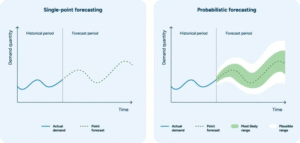
Inset: Point Forecasting vs Probabilistic Forecasting
There are several examples that illustrate this well
- Every June, the India Meteorological Department releases its monsoon forecast, a technically sophisticated exercise, publicly trusted, and yet have routinely been unable to pin down the rainfall distribution that actually matters. The IMD might correctly predict “normal” rainfall for the season in aggregate, while Maharashtra faces drought and Assam faces floods simultaneously. The point forecast was technically accurate but practically not useful.
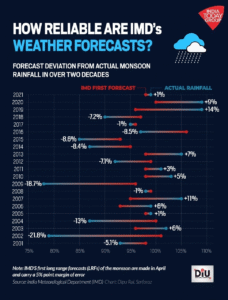 Source: India Today
- Every IPL season produces a wave of confident pre-tournament prediction analysts such as former cricketers, fantasy league algorithms about which teams will make the playoffs – usually the incumbents/defenders such as Chennai Super Kings or Mumbai Indians are fan favorites in this case. The 2025 season is perhaps the biggest dismissal of this theory – when after a roughly 17 year title drought Royal Challengers Bangalore won their maiden title when most had written them off.
The issue is not the absence of information. It is the presence of overconfidence. Experts build models that are internally consistent but fail to account for the base rate of how often similar predictions have historically been wrong. Below are a few guidelines on how to forecast properly
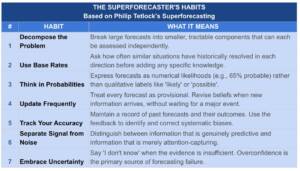
From Point to Probability: Forecasting Done Right
There is however, a segment of forecasting that provides more relevant outputs, not because of superior information, but because the researcher here has updated their beliefs frequently, thought in probabilities rather than certainties, and were willing to revise their forecasts at the right moments by
- decomposing problems into smaller, tractable components
- assigning numerical probabilities and tracking their accuracy over time, creating a feedback loop that improved calibration and
- distinguishing between what was knowable and what was genuinely uncertain.
This disposition has a name in everyday Hindi that captures something close to it: anumaan – the practiced art of rough estimation, calibrated by experience (e.g a seasoned kirana owner estimating how much stock to order before a festival isn’t making a point forecast; she is running a probabilistic model in her head, shaped by years of feedback).
The underlying discipline is probabilistic thinking using a well-constructed forecast that does not produce a single answer but a distribution of outcomes with associated likelihoods. Similarly in venture capital, the forecast that matters most is not what a company earns next quarter or year but rather whether a structural shift in technology, consumer behaviour, or regulation will produce a category of businesses that did not previously exist, or will reorganise an existing one and is applicable across categories – from ‘legacy’ manufacturing businesses to frontier technology startups.
Auxano Lens: Megatrends over Milestones
At Auxano, our framework for identifying investment opportunities is built around emerging megatrends – structural forces that operate over a horizon of five to seven years and create compounding demand for a new type of solution. The core thesis here is not to forecast or predict where businesses will end up (in terms of revenue or valuation), but to understand the core value drivers and what is the likely impact they will have on the return profile.
We structure this by segmenting businesses into three categories:
- category creators (new markets, new products)
- market creators (existing products, new markets), and
- market owners (increased efficiency in existing markets).

Forecasting future returns in this context requires going beyond financial models. It requires an assessment of
- whether the founding team understands the problem at the level of the person experiencing it
- whether the revenue model is built to survive conditions the current market has not yet tested, and
- whether the business is positioned to grow as the megatrend matures rather than peak early.
This is further reflected in our portfolio companies where we have invested across segments
- From hyperlocal delivery and AI-enabled content production
- To data privacy and private market intelligence solutions
- To large data modelers and FTL logistics providers
Takeaway
Prediction will always be imperfect. The goal is not to eliminate uncertainty, but to reason through it with discipline.
The investor or analyst who acknowledges what they do not know, updates frequently, and builds frameworks rather than point forecasts will, over time, outperform those who do not. Trends are visible before they are obvious.
The work is in learning to look early, and to look clearly (vs looking far and wide).
Author
Aditya Golani