

Every generation has its own definition of wealth.
There was a time when wealth meant live stocks, owning gold, then came fixed deposits, followed by real estate as the ultimate aspiration. Eventually, the public stock market caught everyone’s attention.
Today, conversations have expanded to startups (from seed capital to Unicorn status) – private markets and venture capital. Yet one thing has remained constant – People have always looked for a faster way to grow their money.
Few dialogues from Indian cinema have remained as memorable as this one from “Phir Hera Pheri”. Even today, people smile when they hear it: “21 din mein paisa double” (Double your money in 21 days).
The line became famous because it reflected a temptation that every person/investor at some point, has wondered whether wealth can be created quickly…
Can wealth really be created quickly?
For decades, different versions of that 21-day promise appeared in various forms. Some came as speculative investment schemes (ponzi schemes); others came as informal market opportunities offering returns that seemed too attractive to ignore.
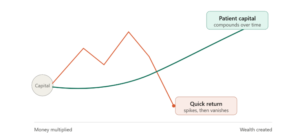
Over the time, many disappeared as quickly as they appeared. Because they all shared one structural flaw: they focused on multiplying money, not creating value…
Money – does not create wealth on its own. Money moves from one account to another.
Wealth – is created only when that money helps build something that did not exist before.
That distinction has quietly shaped the mindset of the Indian investor. Over time, the question changed from “How quickly can I make money?” to “How is value being created?” That shift is where patient capital begins.
Wealth begins where value is created
An entrepreneur identifies a problem and builds a solution that customers are willing to pay for.
When value is created, businesses grow – When businesses grow, more jobs are created -When jobs are created, household incomes rise.
When this cycle continues over time, wealth begins to compound.
This is why sustainable investing has always been connected to productive businesses rather than promises.
How venture capital fuels this value loop –
An entrepreneur might have a brilliant idea, but turning that idea into a business that serves millions requires more than ambition—it requires patient capital.
This is exactly where Venture Capital (VC) and Alternative Investment Funds (AIFs) enter the picture.
A VC fund does not just buy shares; it provides fresh capital to the company that allows founders to
- hire talent,
- build products,
- strengthen technology,
- reach new customers
- and expand into larger markets.
Patient capital does not seek immediate returns. Venture capital funds typically have a life of 8–10 years, giving portfolio companies the time to build, scale and mature.
Regulation built confidence
As India’s startup ecosystem expanded, capital alone was no longer the defining factor for success. Trust became equally important.
Investors wanted confidence that their money would be managed through defined processes.
Founders wanted investors who could support growth beyond writing a cheque.
This is where the Alternative Investment Fund framework changed the landscape.
When SEBI introduced the AIF Regulations in 2012, it was more than a regulatory milestone. Since the introduction of the AIF Regulations in 2012, the industry has grown to 1951 registered AIFs, with investor commitments exceeding ₹16.94 lakh crore as on March 2026 (source: SEBI) , while India today is home to over 2 lakh DPIIT-recognised startups (DPIIT) backing by these institutional pool.
As the industry matured, the regulatory framework matured with it. Valuation standards became more structured, disclosures expanded, reporting expectations increased and governance practices became stronger
Regulation did not remove investment risk (it’s inherent to business). What regulation created was confidence. Confidence that capital would be managed responsibly.
Auxano Journey with this Evolution
When Auxano began investing through Special Purpose Vehicles (SPV) in 2016, India’s startup ecosystem was entering a different phase. Startup India had just begun creating momentum around entrepreneurship, founders were building for a larger scale, and domestic capital was slowly finding confidence in private markets.
Our journey evolved alongside that ecosystem— progressing from SPV investing to managing institutional Category I and Category II AIF structures—but the investment philosophy remained unchanged:
- partner with founders who were solving real problems,
- build governance into every stage of the investment lifecycle,
- and remain patient while businesses compound value.
Our journey reflects this thesis in action. By partnering closely with founders, supporting them through different stages of growth, and remaining invested beyond the early years, we had successfully unlocked multi-fold exit returns from our early investments. These outcomes reaffirm a simple principle: when patient capital is backed by disciplined governance and a long-term perspective, it resonate that the strongest returns are created by building value, not chasing it.
Way Forward –
In the world of venture capital, returns are realised over the life of the fund (typically 8-10 year time horizon). Wealth is not created when money changes hands, it is built when growth capital fuels a business, backed by strong corporate governance and the time required for value to compound.
The maturity of India’s startup ecosystem is reflected not only in the growing number of startups and AIFs, but also in successful exits through
- secondary transactions
- strategic acquisitions
- and IPOs listing.
These exits return money to investors, delivering real wealth as the ultimate reward for their patience.
Author,
Rakesh Rana