

In the early 1980s, a forecast prepared for AT&T projected that about 900,000 Americans would be using cell phones by 2000. The actual figure was roughly 109 million, over 100 times higher. As the story goes, AT&T read the forecast as proof the technology had little future, stayed out, and a decade later paid over $11 Bn for McCaw Cellular to get back in.
The forecast was not careless. It did what most forecasts do: it took the market that existed, a handful of business users and bulky car phones, and projected it forward. The error was assuming the market would stay the shape it was.
That error is the subject of this piece. Valuing a company in a known market is arithmetic. Valuing a company that is creating its market is judgement, and where an investor enters the story decides how much of that judgement they pay for.
Why Forecasts Break
India ran the same experiment in September 2016. When Jio launched, average data prices fell from roughly ₹152 to ₹10 per GB, and monthly mobile data consumption went from ~200 Mn GB to over 1 Bn GB within six months. Any projection anchored on pre-launch pricing would have missed it by the same naive logic
Both episodes share a lesson: when price, convenience or access changes sharply, the old market stops being a guide to the new one.
For an investor, this cuts both ways. A TAM built from history will undervalue the best companies, and a TAM built from imagination will overvalue the worst. The discipline is knowing which of the two you are doing.
Two Kinds of Unknown
At Auxano, we separate two types of company. A category creator unlocks a new market through an innovative solution. A market creator creates new consumption within an existing market.
Jio is a market creator. Telecom already existed, but Jio changed the price at which consumption begins. The risk is whether the economics survive once subsidy and novelty fade.
A category creator faces a harder question: will the category be allowed, understood and paid for at all? Dream11 built fantasy sports into an ~$8 Bn business, until Parliament passed the Promotion and Regulation of Online Gaming Act in August 2025, banning real-money games. With ~86% of its revenue reportedly coming from those formats, the category didn’t fail commercially. A rulebook written after the fact redefined it out of existence.
The Pioneer’s Paradox
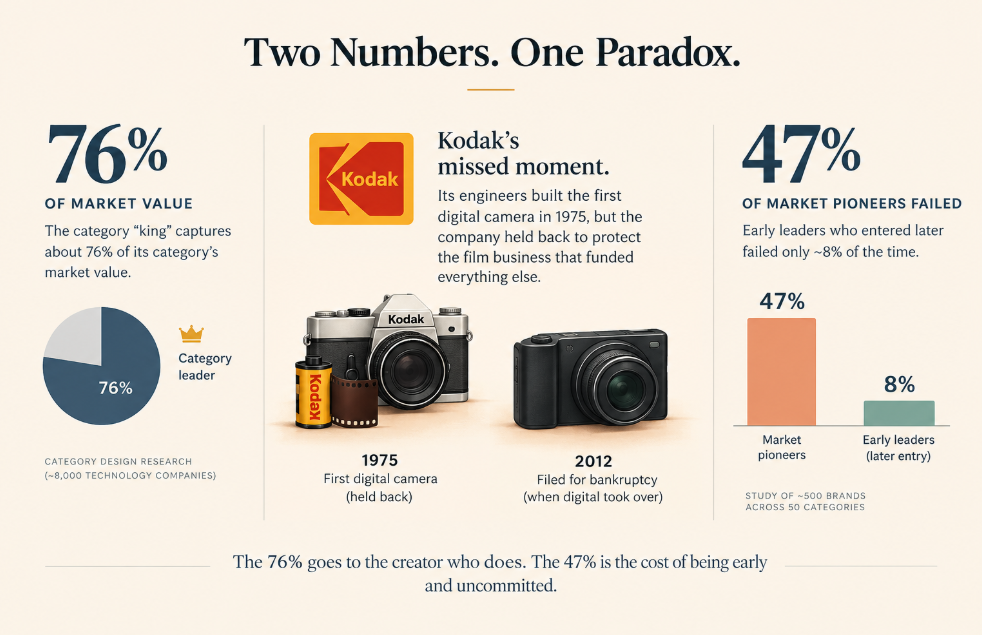
Two numbers frame this debate. Category design research covering ~8,000 technology companies found that the category “king” captures about 76% of its category’s market value. Yet a study of ~500 brands across 50 categories found that 47% of market pioneers failed, while early leaders who entered later failed only ~8% of the time.
Kodak shows how both can be true. Its engineers built the first digital camera in 1975, but the company held back to protect the film business that funded everything else. When digital took over, the creator of the category was not the one that owned it, and Kodak filed for bankruptcy in 2012. Category creators survive not by inventing first, but by committing to the category they created, even when it threatens their own cash cow, and by funding it through the long stretch before the mainstream arrives. The 76% goes to the creator who does that. The 47% is the cost of being early and uncommitted.
Where You Enter Decides What You Own
Between early adopters, who buy a vision, and the mainstream, who buy proof, lies a gap that kills many good products. The earlier an investor enters, the more upside they buy, and the more uncertainty, time and dilution come with it.
Dilution is the part of the story that quietly compounds. Think of an investor who owns a slice of an orchard. Every time the orchard raises fresh money to plant more trees, the slice shrinks a little. One round is a small trim, but rounds multiply each other, the way apples into apples is apples squared. A second round takes a bite out of an already-bitten slice, and a third bites into that.
Now compare two orchards. One grows a familiar fruit, and customers are already lining up. The other grows a fruit nobody has tasted, so it must teach people to eat it before it can sell it. That education takes time, time needs runway, and runway often means one more round. By the day the market arrives, the investor in the second orchard owns a visibly smaller slice and needs a much larger harvest for the same return.
That is the quiet tax on uncharted territory. Category creators are not worse businesses. Their hurdle simply rises with every year the market takes to show up.
Exits follow the same logic. Market creators usually have an obvious set of buyers, because acquirers already understand the revenue pool. Category creators often have to wait until the category has a name, a budget line and a few proof points before anyone pays up.
How We Process This at Auxano
We pay for proof, and we hold possibility as optionality.
Our conviction is that the best moment to back a new category is just after it has shown it can be bought. We arrive once real customers are paying and the early pull has started to look like a pattern. We simply refuse to pay a category creator’s price while the category is just a promise.
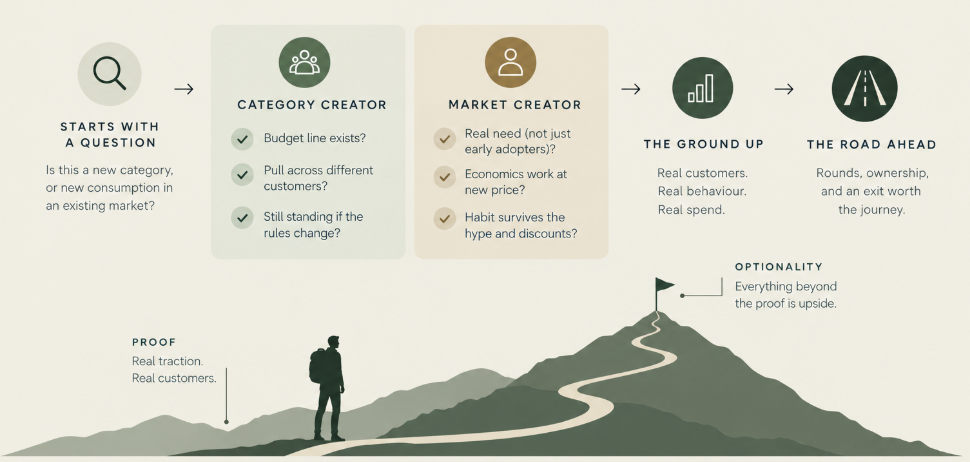
Every conversation starts with a plain question: is this a new category, or new consumption in a market that already exists? The answer decides what we test next.
For a category creator, we want to know whether anyone already has a budget line for this, and whether the pull holds up across different customers rather than resting on one friendly logo. We also ask the uncomfortable one: if the rules or definitions around this category changed tomorrow, what would still be standing?
For a market creator, we want to know whether the people who weren’t buying before genuinely need this, whether the economics still work at the new price, and whether the habit survives once the novelty and the discounts fade.
We build our view of the market from the ground up, from how real customers behave, stay and pay, and we price only what that evidence supports. Anything beyond it is optionality, not something we pay for. We also look at the road still ahead: how many more rounds the company is likely to need, how much of it we will still own when it arrives, and whether the exit at the end of that road is large enough to be worth the journey.
Takeaway
In 1980, a forecast missed an entire market by a factor of a hundred, and not because anyone couldn’t do the maths. The maths was perfect. It was just a wrong assumption of the old market stops being a guide to the new one.
And Being right about the future is not enough. You have to enter before the upside is priced in, but after the business has earned conviction. Too early, and you finance uncertainty. Too late, and you pay for someone else’s foresight. It’s in the narrow window in between, when the founders have done the unglamorous work and the part nobody photographs.
That’s the window we wait for. That’s where we put our conviction.
Author,
Kushagra Sharma