

In the 1950s, researchers in Japan measured a single bar of the giant timber bamboo (aka madake) growing 121 cm in 24 hours (roughly 5 cm/hour) – fast enough that one could sit beside it and watch it grow.
The same bamboo has another, far less visible habit. Madake flowers only about once every 120 years, and when it does, groves across Japan, China and the rest of the world flower at roughly the same time, as if running on a shared internal clock. The last such flowering, in the 1960s and 70s, wiped out entire groves, which then took years to re-establish from seed.
This growth happens in the following phases:
- A new bamboo grove spends its first several years building an underground network of roots. The shoots it sends up in that phase are thin and fragile
- Once the network is established, each new shoot draws on the stored energy of the entire system. That is what allows bamboo to grow up to ~1 metre in a single day and reach close to its full height (up to ~20-30 metres) within a couple of months.


Inset: diagram of a bamboo roots network vs the visible culms/stem
Roots Before Shoots: The Science of Slow
Bamboo is technically not a tree at all, it is a grass, and one of over 1,400 species in its family with India holding the second-largest bamboo variety after China – a large share of it in the Northeast.
In Mizoram for e.g. the dominant species the local bamboo known as mautak, flowers only once every ~48 years, and when it does, it flowers all at once across the entire region before dying off. The event is called Mautam (literally, “bamboo death”) and for good reason given its historical impact on the state –
- The flowering produces a massive, sudden supply of seeds, which in turn triggers an explosion in the rat population.
- Once the seeds run out, the rats move on to the paddy fields and grain stores. The Mautam of 1959 led to a severe famine in the then Mizo Hills district of Assam.
- The perceived lack of a government response fuelled the rise of the Mizo National Front, a two-decade-long insurgency, and eventually the formation of Mizoram as a full state in 1987.
- When the next Mautam arrived in 2006-08, the state was prepared, having spent years planning rat control, crop diversification and food stocks in advance.
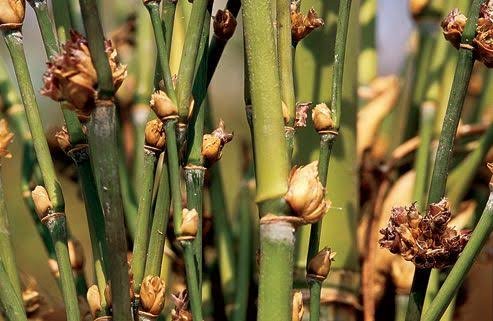
Inset: Bamboo flowering during the Mautam in Mizoram (Source)
This growth pattern (long nothing, then everything) shows up across several domains of nature and science:
- Periodical cicadas in North America spend 13 or 17 years underground as nymphs, and then emerge by the billions within a matter of weeks.
- Closer home, the Neelakurinji in the Western Ghats blooms only once every 12 years, carpeting the hills of Munnar in blue (most recently in 2018, with the next bloom expected around 2030).
- In microbiology, a bacterial colony goes through a “lag phase” where it appears dormant but is actually adapting to its environment and building the machinery it needs, before entering exponential (log) growth.
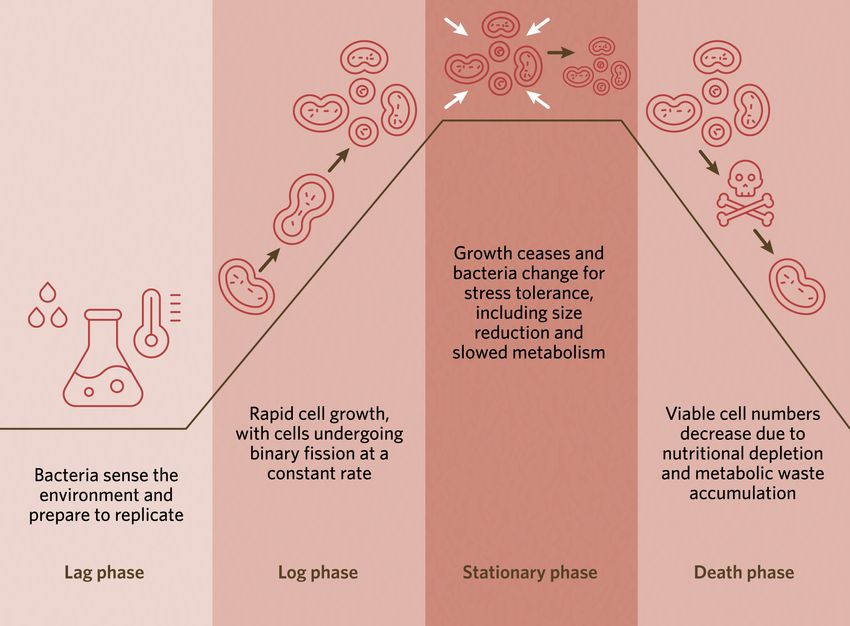
Inset: The bacterial growth curve and its lag, log and stationary phases (Source)
Businesses and economies are no different:
- Global: Amazon was founded in 1994 and posted its first full-year profit only in 2003. Nvidia launched its CUDA platform in 2006 and spent the better part of a decade on a bet that was largely ignored outside research labs, until deep learning (and later, generative AI) made it the foundation of the entire AI stack.
- India: UPI did not appear out of nowhere in 2016. It sat on top of roots that took the better part of a decade to lay – NPCI (2008), Aadhaar (2009), IMPS (2010), and the Jan Dhan accounts (2014). From launch, it took a few years to find its footing, and today it processes over 20 Bn transactions a month.
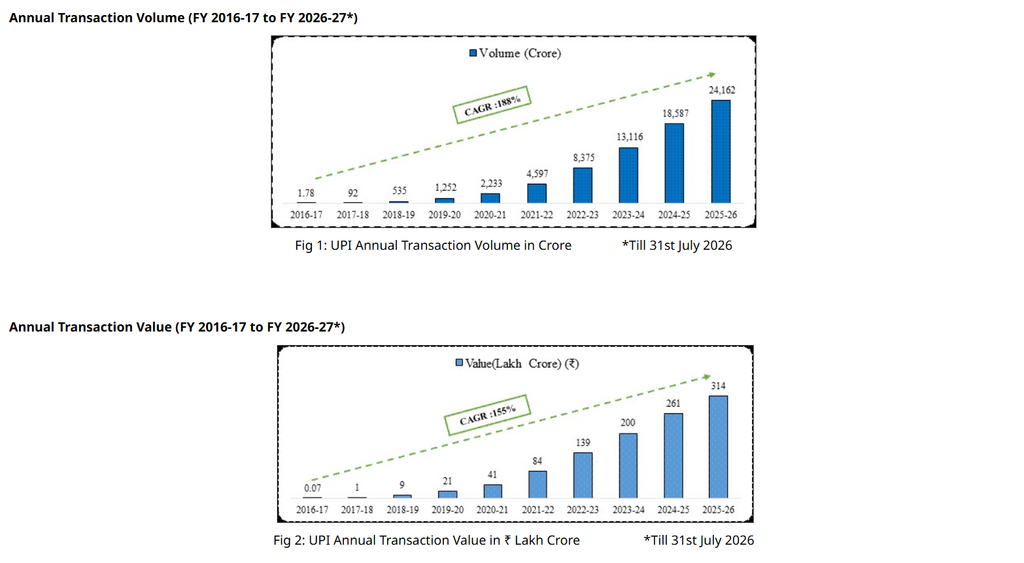
Inset: UPI transaction volumes and value since launch (Source)
The Math of the Invisible: Compounding, Returns and Valuation
The financial equivalent of bamboo’s growth is compounding (or as Warren Buffet calls it ‘the eighth wonder of the world).
Take ₹1 lakh compounding at 15% a year:
- After 10 years: ~₹4 lakh
- After 20 years: ~₹16 lakh
- After 30 years: ~₹66 lakh
Roughly three-quarters of the total gain arrives in the final 10 years. For the first decade, the investor has very little to show for their patience, and that is exactly the point at which most people give up or switch strategies. As Charlie Munger put it, “The first rule of compounding is to never interrupt it unnecessarily.”
The same shape shows up at a much larger scale: The Sensex started at a base of 100 in 1979. It took 11 years to cross 1,000 (1990) and another 16 to cross 10,000 (2006). The next 70,000 points took 18 years, with the index crossing 80,000 in 2024. Same index, same economy, very different-looking decades.

Inset: The Sensex since inception (Source)
However, this long term growth also serves an important reminder of the time horizon one is considering during investments ‘the long run’ can be an indefinite period (and as John Maynard Keynes put it – “In the long run, we are all dead”)
Auxano: Growth is in the Name
Auxano (owk-san-o) is literally the Greek word for “to grow” or “to increase”, and that idea has shaped our philosophy from day one. We have always believed that the most durable growth is the kind that is built underground first.
Venture capital is perhaps the purest example of the bamboo principle in finance. A typical fund runs for ~10 years and follows the J-curve: the early years are spent deploying capital and absorbing write-downs while returns look flat or negative, follow-on rounds start marking up the better companies in the middle years, and exits in the later years convert paper value into actual distributions (DPI), usually led by a handful of companies. As the line often attributed to Lenin goes, “There are decades where nothing happens; and there are weeks where decades happen.”
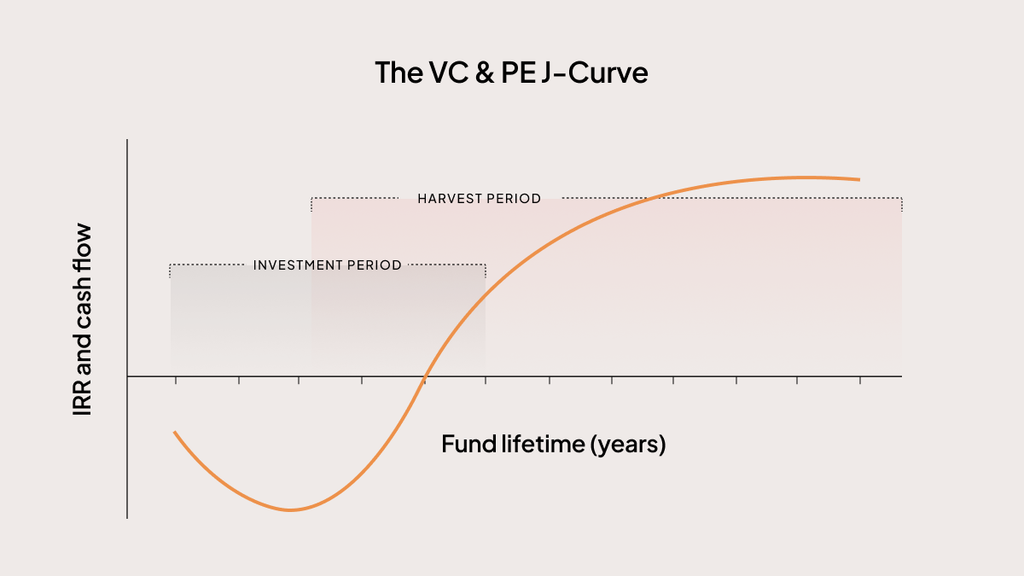
Inset: The J-Curve of a typical VC fund (Source)
Our own journey has followed a J curve over the last decade, where we have
- Invested in 38+ companies in across 8+ sectors
- Realised 6+ exits including 3 full exits
- Rs 100 Cr+ deployed across 2 funds/vehicles
We see the same pattern in one of the companies we evaluated recently. The company has been in its space for over a decade, with commercialisation that would look early-stage on a revenue screen. But over those ten years it has built two things that cannot be bought or rushed with capital: a proprietary data moat, and a network of relationships and trust across its industry. With the roots in place, it is now moving into its next phase of growth.
Not every company that has been quiet for a decade is a bamboo grove, of course. Some are just seeds that never sprouted or just did not grow as was needed (refer our previous blog on this topic). The questions we ask to tell the two apart are simple in principle:
- What has been built underground and can it be measured?
- Could a well-funded competitor replicate it in 18-24 months?
- Has the constraint shifted from building to scaling/selling?
Our role is not to hurry the bamboo. It is to recognise when the roots are ready, and to be there with the right capital and support when they are.
Takeaway
Every overnight success has a root system that nobody photographed. Whether it is a bamboo shoot, a payments network or a startup, the visible growth is the last chapter of a much longer story.
Compounding is not just slow, it is deceptive. For years, the line looks flat, and patience looks indistinguishable from stagnation. The skill is in knowing which one you are looking at.
The bamboo that grows a metre in a day is not fast. It is simply finished with the part nobody sees.
Author,
Aditya Golani