
In 1978, the first satellite of the modern Global Positioning System (GPS) was launched into orbit. Over the next two decades, the project required billions of dollars, cutting-edge atomic clocks, and a massive network of ground control stations. The engineering required to maintain a constellation of satellites 19,000 kms above Earth was huge.
In the tech industry, we often assume that whoever builds the foundational infrastructure captures the majority of the wealth. It is easy to look at a massive orbital network and assume the hardware itself is the ultimate prize.
But that isn’t where the compounding economic value was built.
The companies that generated trillions of dollars in market capitalization from GPS didn’t build rockets, and they didn’t manufacture satellites. Companies like Uber, Google Maps, and global logistics giants simply treated the multi-billion-dollar infrastructure as a baseline commodity. They didn’t try to own the space race. Instead, they relied on a methodical process of owning a specific, high-value workflow on the ground.
They isolated a single variable: a user needing a ride, or a fleet needing a route. They built their applications on top of the signal.
When a massive new technological paradigm emerges, our first instinct is often to assume we must compete at the foundation. But more often than not, the true defensible moat is hiding in plain sight at the application layer.
The Enterprise System Shift
Recently, we faced a similar pattern of market assumption. At Auxano Capital, we published a deep dive into the next great technological re-platforming: The Enterprise AI Horizon – Investment Thesis. Understanding where structural value is being created, before it becomes obvious, is critical to our strategy. When we say we back category creators, we mean exactly this.
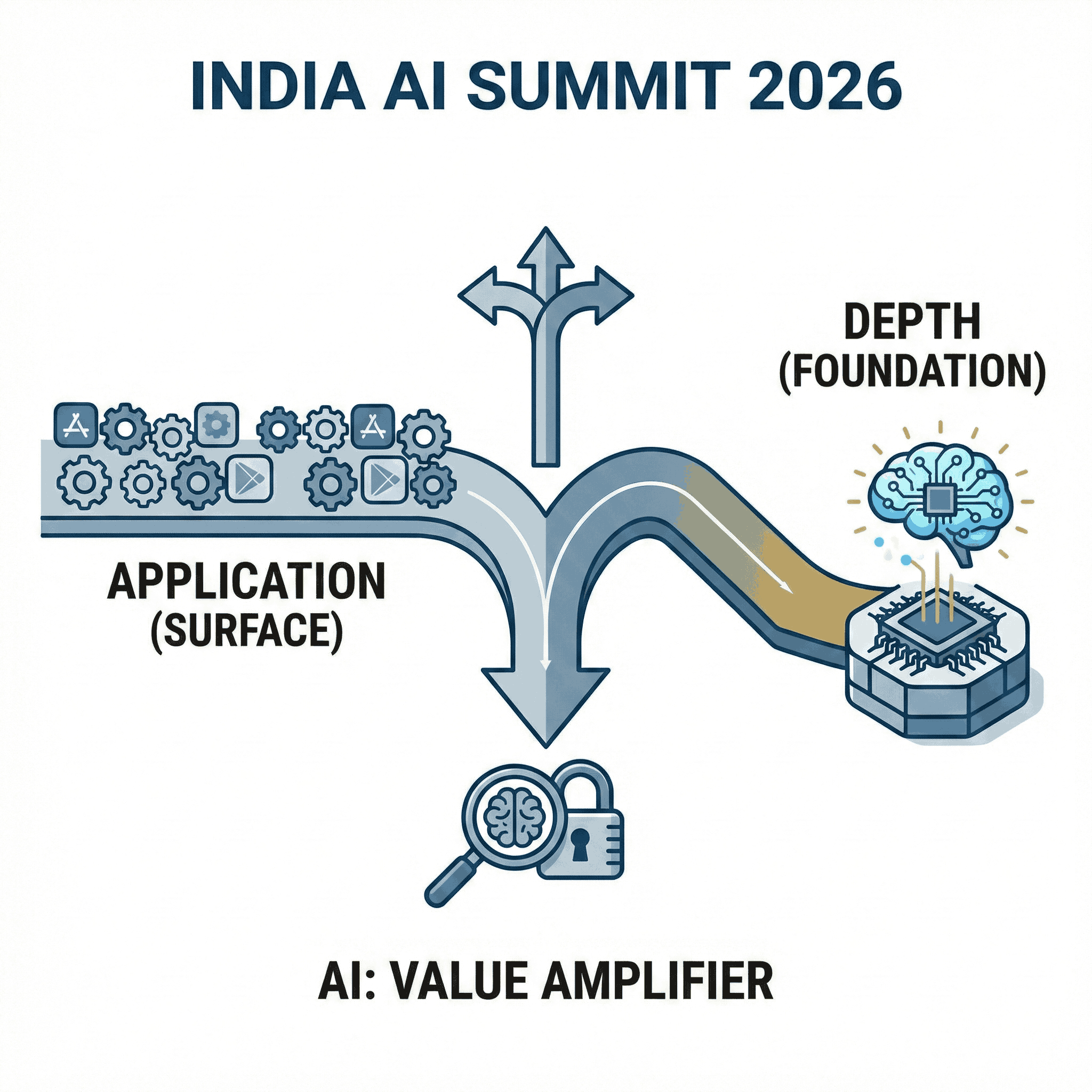
Today, the AI ecosystem is fixated on satellites (the ones we talked about in the earlier paragraph).
We are looking at an estimated global AI data center capital expenditure of $5.3T required by 2030. Building a single frontier foundation model now requires roughly $450M to $1B+ in total data and compute build costs. It would be easy to look at this capex requirement and assume that the only way to win is to engage in a multi-billion-dollar infrastructure war.
However, we wanted to take a methodical look at the underlying economics. We started isolating the variables of where capital was actually converting into recurring revenue.
Our first step was to look at the baseline models. What we found was a rapid commoditization of intelligence. Inference costs have plummeted 280x in just 18 months. The cost of generating a token is trending toward zero, and highly optimized open-weight models are shifting the competitive moat away from pure parameter scale. The foundational models are becoming the new GPS signal, ubiquitous and cheap.
We decided to look higher up the stack. Enterprise AI spending has surged from $0 to $37 billion in just three years, capturing 6% of the global SaaS market. But when you break down that $37 billion, a clear winner emerges: $19 billion (51%) sits squarely at the application layer.
The market is moving away from general-purpose Horizontal AI, which scales through broad consumer reach but lacks deep business integration. These are domain-specific applications that integrate directly into a company’s daily workflows to automate processes and augment human decisions.
Every enterprise AI company looks promising at the demo stage. But currently, 70-85% of enterprise AI initiatives fail to meet expected outcomes, dying in the “POC Trap” between a pilot and true production deployment. The companies that break through this barrier are the ones that go deep enough to save a tangible dollar on a specific line item: a headcount avoided, a process eliminated, or a decision accelerated.
For example, across our own portfolio, companies have reported over 70% efficiency gains in internal reporting and product development by using targeted AI tools. Platforms like InfoBay.AI are actively solving the “hallucination” problem by providing curated synthetic data to hyperscalers, while Datasafeguard is automating complex privacy impact assessments with 99%+ scanning accuracy. They are pinpointing specific pain points, like data compliance and accuracy and deploying precision fixes.
A vertical AI application doesn’t need to rebuild the entire foundational model. It just needs to fix a specific operational variable. By embedding into legal, financial, or engineering workflows, Vertical AI compounds its moat through proprietary data and regulatory lock-ins that general models simply cannot replicate. This is why 70% of all AI venture deals in Q1 2025 were concentrated in the application layer. These platforms boast an 88% enterprise retention rate because they directly impact a business’s bottom line.
For startup founders and investors, this is a crucial lesson in value capture.
- When a foundational technology like AI breaks into the mainstream, the temptation is always to build infrastructure or launch a generic horizontal wrapper.
- But before you throw capital at a capital-intensive problem, take a breath.
- Infrastructure is dominated by global incumbents, and models are increasingly commoditized.
- Enterprise value flows upward, meaning the strongest investment opportunities lie where companies own customer workflows, proprietary data, and long-term relationships.
You might just find that you don’t need a billion-dollar data center. You just need to own a specific enterprise workflow.
Author,
Tanmay Gajbhiye