

In the wild, a deer stands at the edge of a pond, drinking water calmly and without hurry. Somewhere nearby, an orangish figure lurks in the tall grass – with the familiar black stripes and white accents.
The deer however, cannot see it though, not because it is not looking but because they have dichromatic eyes (can only detect blue and green as primary colours with no detection of reddish hues, refer the image below).

The tiger hiding in plain sight – with its orange coat blends seamlessly into the landscape. The threat is right there, fully visible to any other observer and yet, to the deer, it simply does not exist. The result is familiar – frozen, wide-eyed, caught completely off guard. To cope with this, deers have sharp hearing – running away even if a twig gets snapped in the forest. But the blind-spot persists (imagine a deer in the headlights), and deer are not the only animals to be affected by this –
Patterns & (Eco)systems
All organisms have perception and pattern recognition that suits their particular ecosystem and environment.
- Infrared/heat vision => snakes and other reptiles
- Sonar/echo location => bats
- Smell/olfactory sense => polar bears
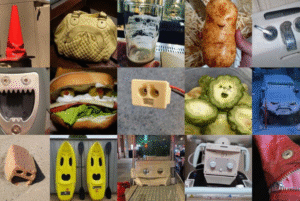
Humans too have strong pattern recognition – processing patterns via neural networks in regions like the visual cortex, temporal lobe, prefrontal cortex, and hippocampus, allowing stronger threat detection and person identification. However, this ability can misfire such as identifying faces in everyday objects such as clouds, cars or natural landscapes (known as Pareidolia)
However, what gives humans an edge over other animals is combining this pattern recognition with the ability to assess future outcomes over extended periods, involving prefrontal cortex integration of past patterns in step-wise manner (similar to how auto-correct tries to predict the next word based on prior data). This step-wise reasoning however, can lead to myopic/short term decisions, amplifying errors in long-term scenarios without explicit lookahead. This can be understood best through several ecological case studies most notably the Yellowstone and Sahara
- In Yellowstone National Park, wolves were eradicated by the early 20th century, causing an increase in the elk population that overgrazed riverbanks, leading to erosion and altered river courses and harmed the entire ecosystem. The reintroduction of wolves in 1995 restored this ecological balance and stabilized the natural habitat.
- The Sahara, now one of the largest deserts in the world, was green 11,000–5,000 years ago but transitioned to desert partly from overgrazing by pastoralists, reducing vegetation and moisture feedback.
VC Ecosystem
Just like any other ecosystem, venture capital also has its own blind spots but unlike other ecosystems there are no predators and prey in venture capital – there is however a power dynamic, and it shifts dramatically depending on where a company sits in its lifecycle.
- When a company is early, the power sits firmly with investors. Capital allocation is scarce and the investor chooses who gets access and who does not.
- When a company is large (scaling revenue, proven unit economics, and actual PMF), the dynamic reverses. The founder chooses which colour of money to let onto the cap table. The investor needs the allocation.
This shift creates different investor priorities at different stages:
- Early stage investors operate under a ‘portfolio logic’ – backing many companies knowing most will not work, prioritising the founding team, the market size, and early traction. Diligence is fast, legal review is light, and governance is minimal, not out of negligence, but because at this stage, the company barely exists yet.
- Growth stage investors operate under a ‘fund returning logic’ – larger fund sizes demand outliers, not a portfolio of decent outcomes but a handful of companies that can return the entire fund on their own. Every investment must be capable of scaling to a very large number, and diligence is conducted on how well the company can reach this scale (since only a handful of companies in a space do.
The problem is not in these differing priorities – but that these can occur at the same time especially for companies that are between the early and growth stages, with no explicit acknowledgment that the rules changed in the middle.
Auxano: What We See
While the above is part and parcel of any maturing ecosystem, it has a specific and recurring consequence: compliance gaps and governance failures that compound silently over time.
We have seen this play out across multiple companies,
- Founder remuneration set at the early stage – often ahead of actual traction, which becomes difficult to revisit later.
- Related party engagements – a founder’s parallel entity providing services, a family firm in the supply chain, can be legitimate but still represent undisclosed value leakage if never formally documented or considered from an arm’s-length perspective .
- Inconsistent GST treatment and informal revenue recognition – appears innocuous at early stages but creates regulatory exposure as scrutiny increases with scale.
- Non-standard foreign investment structures – convenient at the early stage, may not sit comfortably within RBI guidelines when a larger, institutional round takes place.
- Inadequate legal and secretarial records – e.g. board resolutions never formally passed, cap table entries living on email threads, inadequate register of members, remain the most common category we encounter (and one we covered in detail in an earlier blog).
Later stage investors are not blind to these issues, they simply face a different incentive. In a competitive, oversubscribed round, raising governance concerns risks losing allocation entirely.
For co-lead or participating investors writing smaller cheques, questioning such practices can be framed as “controlling” or “founder-unfriendly,” meaning all stakeholders end up looking away from the very things that matter most.
The consequences of this collective inaction are not hypothetical — they are visible across the ecosystem in various case studies.
- From a leading EV mobility company shutting down due to inadequate controls across its related manufacturing entity,
- to a large edtech player collapsing amid governance lapses and irregular practices,
- to a social media platform getting flagged for internal control weaknesses and revenue misstatement.
In each case, the seeds were planted early and the blind spots were structural long before the collapse.
At Auxano, we are conscious that we are not always the first investor in a company (entering after a seed or pre-Series A round has already closed). That means we are not just evaluating the company, we are also, implicitly, evaluating the quality of the diligence that preceded us.
The goal is not to identify what earlier investors missed in order to score points. The goal is to understand what the actual and potential risk looks like so we can price it correctly and support the founder in addressing whatever needs to be addressed before it becomes a problem downstream.
In practice, this means a few things.
- We run independent legal and financial diligence, regardless of what has already been done. Not because we distrust prior work, but because diligence is context-dependent. A question that was not material at seed may be very material at our entry point.
- We have direct conversations with founders about the things that are hard to say — co-founder tension, customer concentration, the deals that did not close and why. The idea being to understand the team’s thought process and intent vs a black and white classification of issues.
- We look at the ecosystem around the company as a whole –
- Who are the customers, and how stable are they?
- What does the competitive landscape actually look like (not just on a 2×2 matrix), but in terms of where potential customers are being lost?
- Which regulatory bodies have recently updated their policies that can potentially affect the industry?
This creates friction in the short term. But to paraphrase Jim Rohn, one can either choose the short-term pain of discipline and vigilance, or the long-term pain of consequences and missed opportunities.
A (Symbiotic) Way Forward
The deer cannot help its dichromatic vision. The elk in Yellowstone were not malicious. The pastoralists of the Sahara were not trying to build a desert. In each case, individual actors operating rationally within their own constraints collectively produced outcomes none of them intended or could see coming.
But ecosystems that survive (and thrive over long periods) are not the ones where every organism simply optimises for itself. They are the ones where different participants, with different capabilities, create enough checks on each other that no single blind spot leads to adverse outcomes.
That is what a healthy VC ecosystem actually looks like, not adversarial, but symbiotic.
- Early investors building relationships and backing people.
- Growth investors pressure-testing assumptions and strengthening governance.
- Founders who treat scrutiny not as an obstacle but as a forcing function for building something durable.
And across all of it, a shared acknowledgment that different stages require different lenses, and that no single lens captures the whole picture.
Author,
Aditya Golani